In short: in England, most commercial roof repairs don’t need Building Regulations approval, but replacing a roof covering usually does. Once you renew 50% or more of a roof, or your work affects more than 25% of the building’s whole external envelope, the work counts as a “renovation of a thermal element”. Building Control must be told, or the contractor must self-certify through a Competent Person Scheme, and the insulation normally has to be brought up to current Part L standards. Changing the fire performance or weight of the roof brings in Parts B and A as well.
Facilities managers often confuse Building Regulations with planning permission. They are separate regimes and answer different questions. Planning asks whether the work is acceptable in its surroundings; Building Regulations ask whether the finished roof is safe, structurally sound and energy efficient. We’ve covered planning in Do You Need Planning Permission for Commercial Roof Work?. This guide covers the other half: when Building Control needs to be involved in commercial roof work in England, and what the Approved Documents expect.
When does commercial roof work need Building Regulations approval in England?
Building Regulations apply to “building work”. For roofs, that generally covers three situations:
- Re-covering or replacing a roof. Stripping and renewing the waterproofing across a large share of the roof is a renovation of a thermal element. The guidance in Approved Document L defines renovating a flat roof as replacing its waterproofing membrane, so a strip-and-replace of a felt or single-ply roof is caught even if the deck stays.
- Material alterations. If the new covering performs significantly differently in a fire from the old one, or weighs noticeably more (the Planning Portal uses an increase of 15% or more as the marker), the work affects Part B (fire) or Part A (structure).
- New elements on the roof. New rooflights, plant platforms, solar arrays and roof openings can all bring structural, fire and energy requirements into play.
Like-for-like repairs to a small area, patching, replacing individual sheets or rooflights, cleaning and coating maintenance are generally not notifiable. If you’re unsure, ask before work starts, not after.
The 50% and 25% triggers explained
The key thresholds come from the energy efficiency requirements. The renovation provisions apply when work covers more than 50% of an individual thermal element (such as one roof) or more than 25% of the building’s total external envelope. On a typical single-storey warehouse or retail unit, the roof is a large share of the envelope, so a substantial roof refurbishment will often meet both tests.
When the renovation provisions apply, the roof should be upgraded to the “improved” U-value in Approved Document L, Volume 2 (buildings other than dwellings). Under the current 2021 edition that is 0.18 W/m²K for a flat roof or a roof with integral insulation, and 0.16 W/m²K for a pitched roof insulated at ceiling level. The upgrade is expected where it is technically, functionally and economically feasible. The guidance uses a simple payback test of 15 years to judge economic feasibility, which is why an upgrade can sometimes be relaxed on a building with an awkward construction.
In practice this is why “just re-felting the roof” on a commercial building so often turns into a warm-roof build-up with new insulation, raised upstands and altered edge details. It is a regulatory requirement, not a contractor adding scope.
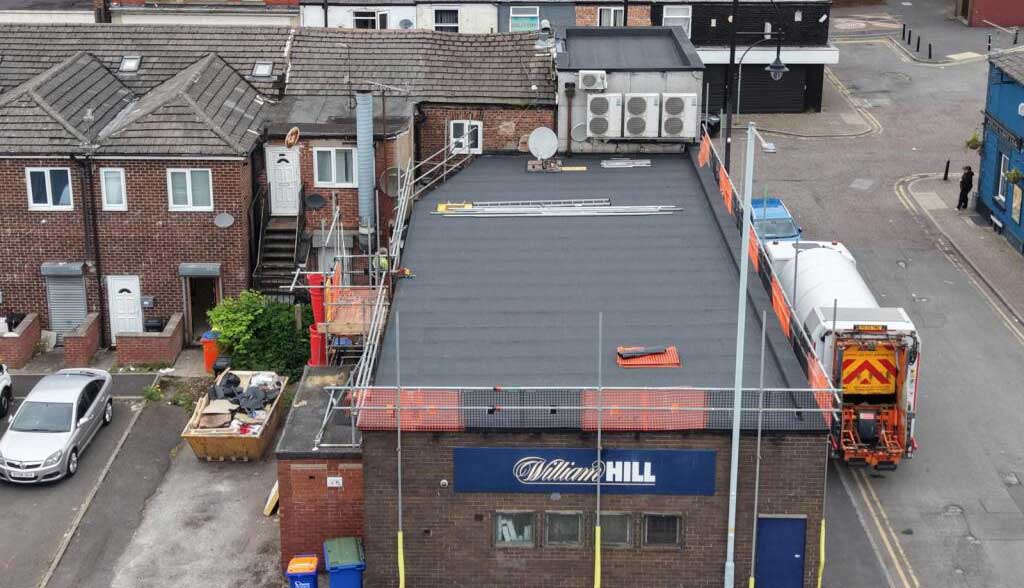
A recent example: at a William Hill betting shop in Edgeley, Stockport, the existing recovery board turned out to be saturated, which ruled out an overlay. We stripped the high and low roofs back to the metal deck and installed a new vapour control layer, insulation to achieve the required U-value, and a two-layer torch-on felt finish on around 250m² of roof, with the shop open throughout.
Which Approved Documents apply to roofing?
| Approved Document | What it covers | When it matters on a roof |
|---|---|---|
| Part L – energy | Insulation levels, U-values, thermal bridging and air leakage | Any renovation over the 50% / 25% thresholds; new rooflights; extensions |
| Part B – fire safety | External fire spread, reaction to fire, compartmentation | Changing the roof covering type, roofs near boundaries, solar PV, roof-to-wall junctions |
| Part A – structure | Loads on the roof structure | Heavier coverings, overcladding, plant, solar arrays, green or blue roofs |
| Part C – moisture | Resistance to weather and condensation | Changing from cold-deck to warm-deck, vapour control layers |
| Part H – drainage | Rainwater drainage | Changing falls, outlet positions or the rainwater system |
| Part K – protection from falling | Guarding where people need access | Roofs with regular maintenance access; new walkways or plant areas |
Fire performance deserves particular attention on commercial roofs. Our guide to fire safety and commercial roofing explains the difference between reaction to fire and fire resistance, and why insulation choice now gets so much scrutiny.
Part L is changing in March 2027
The government has published a new edition of Approved Document L, now titled Energy and Greenhouse Gas Emissions, to deliver the Future Homes and Buildings Standards in England. It comes into force on 24 March 2027 for most building work and on 24 September 2027 for higher-risk buildings, with transitional arrangements for projects already under way.
If you’re planning a large roof refurbishment for late 2027 or beyond, check with your contractor and Building Control body which edition applies to your project. Choosing a specification that comfortably beats today’s minimums is usually cheaper than redesigning partway through.
How approval works: Building Control or a Competent Person Scheme
There are three routes for roof work in England.
- Building notice. The local authority Building Control team is told before work starts, normally at least 48 hours ahead, and inspects the work as it progresses. Suitable for straightforward re-roofing.
- Full plans application. Drawings and specifications are checked and approved before work starts. Better for complex projects, structural changes, or where certainty matters to the client or their insurer.
- Competent Person Scheme. Roofing contractors registered with a government-authorised scheme, such as the NFRC’s CompetentRoofer, can self-certify that roof refurbishment complies. The scheme notifies the local authority and a compliance certificate is issued once the work is complete.
Whichever route is used, the building owner should end up with written evidence of compliance: a completion certificate from Building Control or a certificate issued through the Competent Person Scheme. Lenders, insurers, tenants and buyers will ask for it, so file it with the roof warranty and O&M information.
Higher-risk buildings: a different process
Since October 2023, the Building Safety Regulator has been the Building Control authority for work on higher-risk buildings in England. For design and construction purposes these are buildings at least 18 metres tall or with at least seven storeys that contain at least two residential units, or that are hospitals or care homes. Hotels are excluded.
Roof works on these buildings generally need approval from the Regulator before work starts (the “Gateway 2” stage). That adds months, not days, to the programme. Mixed-use schemes with flats above retail or offices are the ones most often caught by surprise.
What happens if roof work isn’t notified?
Unnotified, non-compliant work can be subject to enforcement, and the local authority will have no record that the roof complies. More commonly the problem shows up later: during a sale, a lease renewal, a refinancing or an insurance claim, when someone asks for the paperwork and it doesn’t exist. Putting that right afterwards usually means opening up the work for inspection, which costs far more than notifying in the first place.
A practical checklist before roof work starts
- Will the work cover 50% or more of any roof area, or 25% or more of the building envelope?
- Is the covering type changing (for example felt to single-ply, or a heavier system)?
- Are rooflights, plant, solar PV or new openings being added?
- Is the building a higher-risk building, or does it contain flats, a hospital or a care home?
- Which approval route will be used, and who is responsible for notifying?
- Has the insulation upgrade been priced and designed in from the start?
- Who will provide the compliance certificate at the end?
Frequently asked questions
Do I need Building Regulations approval to repair a commercial flat roof?
Not usually. Localised repairs and replacing small areas like for like are generally not notifiable. Approval becomes necessary when the work amounts to renovating a large part of the roof, normally 50% or more, or when the work materially alters the roof’s fire performance or structure.
Do I have to add insulation when I replace a commercial roof?
Usually yes. Once the renovation thresholds are met, Approved Document L expects the roof to be upgraded to the improved U-value (0.18 W/m²K for a flat roof under the current guidance) where that is technically, functionally and economically feasible.
Is coating a metal roof notifiable?
A maintenance coating or cut-edge treatment that doesn’t change the roof’s construction, fire performance or thermal element is generally treated as maintenance rather than building work. Overcladding a metal roof with a new insulated system is different and will normally need approval.
Does this guidance apply outside England?
This article covers England. Wales has its own Approved Documents and dates, and Scotland and Northern Ireland have separate systems altogether, so check local requirements for sites elsewhere.
Getting it right first time
RMLFS plans every flat roof refurbishment and metal roofing project with Building Regulations in mind from survey stage, so the insulation upgrade, fire classification and approval route are settled before a price is agreed. If you’re planning roof work anywhere in England and want a clear view of what will be required, get in touch with our team.