When a metal roof — typically a profiled sheet system on an industrial unit, warehouse, or large commercial shed — starts showing its age, building owners are faced with a genuine choice between two very different renewal approaches. Understanding what each actually involves, and when each makes sense, can significantly change both the cost and the outcome of the project, and getting the decision wrong in either direction has real financial consequences.
Why metal roofs eventually need more than routine repair
Profiled metal roof sheets have a long service life, often 30–40 years or more, but they don’t last indefinitely. Fixings loosen and corrode, particularly at penetration points and laps where moisture can sit, and sheet laps can open up or lose their seal over time as thermal movement gradually works fixings loose. Coatings degrade under UV exposure, eventually allowing corrosion to take hold on the sheet itself, typically starting at cut edges, fixing points, and areas where standing water or debris accumulates.
Insulation beneath the sheets, if original to the building, is often significantly below current thermal performance standards — a roof installed in the 1990s or early 2000s may have insulation levels a fraction of what’s now required or expected, and Building Regulations Part L compliance increasingly becomes a factor whenever significant roof work is undertaken, potentially triggering a requirement to upgrade thermal performance as part of any substantial renewal project. At some point, targeted repairs stop being cost-effective — patching individual sheets and fixings on a roof that’s failing systematically simply defers an inevitable, larger cost, and the choice becomes overcladding or full strip and re-sheeting.
Overcladding: renewal without removal
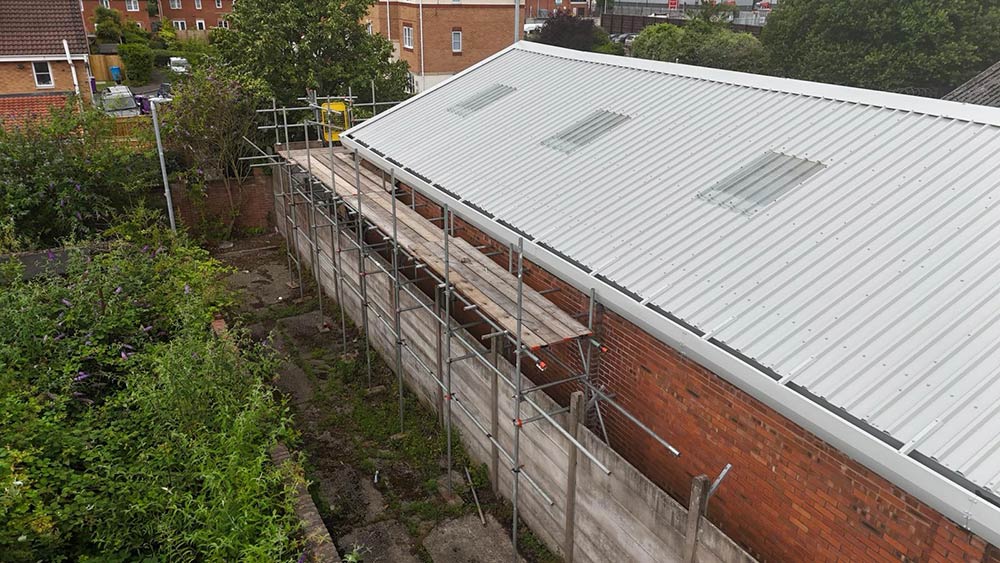
Overcladding involves installing a new layer of profiled sheeting, complete with new insulation, directly over the existing roof structure, rather than removing what’s there. The existing sheets stay in place, providing a working platform and additional weather protection during installation, while the new system above delivers a fresh, weathertight, properly insulated roof. Typically, a spacer system is installed over the existing sheets to create a cavity for new insulation, before the new outer sheet layer is fixed through to the structural purlins beneath, effectively creating a fully renewed, better-insulated roof buildup without removing the original layer.
This approach is significantly less disruptive than full replacement — the building beneath typically remains weathertight throughout the works, since the old roof isn’t removed until the new one is already providing cover, and the project timeline is usually considerably shorter as a result, often measured in weeks rather than months for a typical industrial roof. It’s a particularly strong option for buildings that need to stay operational throughout the works, since business disruption is minimised compared to a full strip-out, and internal areas can generally continue operating with little more than routine noise and occasional access restrictions during the works.
Overcladding works well where the existing structure — purlins and the roof’s structural frame — remains sound and capable of taking the additional load of a second sheet layer, and where the existing roof, while worn, isn’t so far gone that it can’t serve as a stable base. A structural survey is an essential first step, since overcladding adds weight to the existing frame, and older buildings not originally designed with future overcladding in mind may need localised structural reinforcement before the additional load can be safely carried.
Strip and re-sheeting: complete renewal
Strip and re-sheeting means exactly what it says — removing the existing roof sheets entirely, down to the structural purlins, and installing a completely new system from scratch. This is the right approach where the existing sheets or their fixings have deteriorated too far to serve as a reliable base, where there are underlying structural concerns that need to be inspected and addressed directly, or where asbestos-containing materials are present and need to be safely removed rather than covered over (overcladding is not an appropriate solution for roofs containing asbestos cement sheeting, both for regulatory reasons and because it leaves a hazardous material permanently in place beneath a new roof).
Strip and re-sheeting also allows full inspection and, where needed, remediation of the structural frame itself — something that isn’t possible with overcladding, since the existing roof remains hidden beneath the new layer. For buildings where structural condition is uncertain, where there’s a known history of leaks that may have caused hidden corrosion to purlins, or where the roof has reached genuine end-of-life rather than simply needing a refresh, this thoroughness is a significant advantage that overcladding simply can’t offer.
The process typically involves working in controlled sections, removing a limited area of old sheeting, installing new insulation and sheeting in that section, and moving progressively across the roof — this sequencing keeps the building weathertight throughout rather than exposing the entire structure at once, though it does mean the overall programme takes longer than overcladding for an equivalent roof area.
Weighing up the decision
The right choice comes down to a handful of key questions: is the existing structure sound enough to take an additional load? Is asbestos present? Does the project need to minimise disruption to ongoing operations, or is a full shutdown acceptable? What condition are the purlins and structural frame actually in — and is that even known, or does it need investigating? And critically, what’s actually driving the need for renewal — surface-level weathering and thermal performance, or genuine structural deterioration that needs to be addressed directly?
A proper roof survey, ideally including structural assessment of the purlins and frame — sometimes involving core sampling or localised opening-up to check for hidden corrosion — should always precede this decision rather than defaulting to whichever option sounds simpler or cheaper on paper.
Cost and lifecycle considerations
Overcladding is generally the more cost-effective and faster option where it’s suitable, and can extend a roof’s service life by several decades when done properly, effectively resetting the clock on the roof’s weatherproofing and thermal performance without the cost of full structural renewal. Strip and re-sheeting costs more and takes longer, but delivers a genuinely new roof system with full structural inspection built into the process — often the right long-term investment for buildings with 30-plus years of remaining operational life ahead of them, or where the building’s use is expected to intensify (heavier plant, additional loading from solar installation, and so on) in ways the existing structure needs to be confirmed capable of supporting.
Getting the right recommendation
At RMLFS, our metal roofing surveys assess structural condition, existing sheet performance, and insulation levels before recommending overcladding or strip and re-sheeting, so the decision is based on what your specific roof actually needs rather than a one-size-fits-all approach.