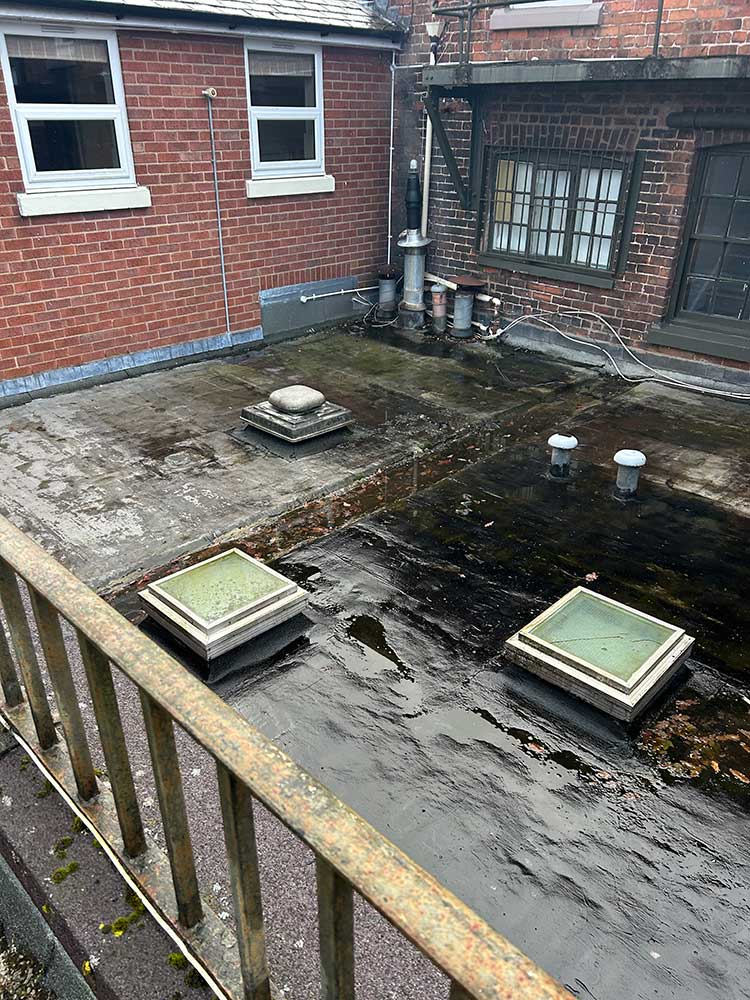
The commercial roof approaching end of its service life presents facility managers with critical decision point that determines not only immediate capital expenditure but also long-term costs, building performance, and asset value for the next 20-30 years. The 18-year-old membrane showing multiple small leaks, visible deterioration, and increasing maintenance costs forces the question: invest £8,000-£15,000 in comprehensive repairs extending life 3-5 years, spend £60,000-£90,000 on overlay system adding new membrane over existing, or commit £100,000-£150,000 to complete replacement providing fresh 25-30 year service life? Each option appears justifiable depending on which financial lens dominates—minimizing current-year capital expenditure favours repair, avoiding complete replacement disruption suggests overlay, while lifecycle cost optimization often indicates full replacement despite highest upfront investment.
For commercial property owners and facility managers across retail, industrial, office, and mixed-use portfolios, these end-of-life decisions shape property performance and costs for decades. The wrong choice—attempting to repair beyond economic viability, overlaying deteriorated substrates, or prematurely replacing serviceable roofs—wastes capital while creating operational problems. Yet the “right” choice isn’t universal: a property planned for sale in 2-3 years has different optimal decisions than one held for 15+ year investment horizon. Buildings planned for solar panel installation require different considerations than those remaining conventional. Properties with tenant lease expirations pending face different constraints than owner-occupied facilities.
This analysis provides comprehensive decision framework for end-of-life commercial roofing choices, establishes criteria determining which option suits specific circumstances, quantifies costs and risk-adjusted returns for each approach, and integrates emerging considerations like solar readiness and sustainability requirements transforming what was purely maintenance decision into strategic asset management choice.
Understanding End-of-Life: When Roofs Reach Decision Points
Not all aged roofs face identical decision points—understanding your roof’s actual condition versus chronological age clarifies timing and urgency.
Defining “End-of-Life”
Chronological age milestones:
- Built-up felt: 15-18 years (approaching expected 20-year lifespan)
- Single-ply membranes: 20-25 years (approaching 25-30 year lifespan)
- Metal roofing: 25-30 years (coating degradation, fastener issues emerging)
Condition-based indicators:
- Leak frequency increasing (from isolated annual events to monthly occurrences)
- Maintenance costs escalating (£2,000-£3,000 annually becoming £5,000-£8,000)
- Multiple simultaneous problems (not single isolated failure)
- Visible deterioration (membrane surface degradation, widespread cracking)
- System integrity concerns (delamination, fastener backing-out across areas)
Financial triggers:
- Annual repair costs exceeding 10-15% of replacement cost
- Warranty expiration removing coverage for future failures
- Insurance survey identifying roof condition as risk requiring action
- Tenant lease negotiations highlighting poor roof condition
Strategic triggers:
- Property sale preparation requiring roof condition improvement
- Major building renovation warranting roof coordination
- Solar installation planning requiring adequate substrate
- Building use change increasing roof loading or performance requirements
Premature vs. Appropriate End-of-Life Assessment
Avoiding premature replacement: A 22-year-old single-ply membrane with isolated repairable problems and otherwise good condition isn’t “end-of-life”—it’s mid-to-late life requiring targeted repairs, potentially delivering 5-8 additional years. Replacing this roof wastes 5-8 years of remaining value (£30,000-£50,000 wasted service life).
Recognizing overdue replacement: An 18-year-old built-up felt with multiple leaks, ponding damage, and requiring £6,000 annual repairs is past economic service life. Continuing repairs beyond this point creates false economy—the £6,000 annual spend becomes £8,000, then £12,000, while roof condition continues deteriorating until catastrophic failure forces emergency replacement at premium cost.
Option 1: Comprehensive Repair and Service Life Extension
Major repair programs address multiple identified problems attempting to extract final service years before inevitable replacement.
When Repair Makes Sense
Appropriate repair scenarios:
- Roof age: 60-80% through expected lifespan (12-16 years for 20-year systems)
- Condition: Fair to good overall with identified specific problems
- Problems: Localized rather than systemic (30% or less of roof area affected)
- Remaining life target: 3-5 additional years economically achievable
- Ownership timeline: Property sale, lease expiration, or major renovation planned within extended lifespan period
- Budget: Replacement capital unavailable but repair funds accessible
Repair program components:
Leak source elimination:
- Failed flashing replacement
- Membrane section repairs/replacement (localized areas)
- Penetration re-sealing
- Edge detail restoration
- Cost: £3,000-£8,000 depending on extent
Drainage system restoration:
- Outlet cleaning/replacement
- Gutter repairs
- Tapered insulation adding falls to ponding areas
- Cost: £2,000-£5,000
Protective treatments:
- Liquid coating systems extending membrane life
- Reflective coatings reducing UV/thermal stress
- Biological growth treatment
- Cost: £8-£15 per m² (£16,000-£30,000 for 2,000 m² roof)
Total comprehensive repair cost: £25,000-£45,000 (25-30% of replacement cost)
Expected outcome: 3-5 additional service years with reduced (but not eliminated) maintenance requirements
Repair Program Economics
Cost-benefit analysis (2,000 m² roof example):
Scenario parameters:
- Current age: 16 years
- Expected original life: 20 years
- Current condition: Fair with identified problems
- Replacement cost: £120,000
Repair option:
- Comprehensive repair cost: £35,000
- Expected extended life: 4 years
- Annual maintenance: £3,500
- Total 4-year cost: £35,000 + (£3,500 × 4) = £49,000
- Cost per extended year: £12,250
Replacement option:
- Immediate replacement: £120,000
- New roof annual maintenance: £2,500
- Total 4-year cost: £120,000 + (£2,500 × 4) = £130,000
- Cost per year: £32,500
Repair advantage: Saves £81,000 over 4-year period (62% cost reduction)
However: After 4 years, replacement still required—the £35,000 repair investment doesn’t reduce eventual replacement cost. The real question: is delaying £120,000 expenditure for 4 years worth £35,000 investment?
Time-value analysis: Investing £35,000 to defer £120,000 capital expenditure 4 years provides:
- £85,000 capital preserved for 4 years (£120,000 – £35,000)
- At 5% investment return: £85,000 × 1.21 = £102,850 (4-year compound growth)
- Plus avoided expenditure time-value
Result: Repair option provides positive return if investment horizon is limited (sale, redevelopment, lease expiration within extended life period)
Repair Risks and Limitations
Diminishing returns: Repairs to deteriorating roofs become progressively less effective:
- First comprehensive repair: 4-5 year extension typical
- Second repair (if attempted): 2-3 year extension
- Third repair: 1-2 years, escalating failure risk
Hidden deterioration: Visible problems often symptomize broader deterioration:
- Membrane repairs address surface issues but underlying insulation/deck problems persist
- Limited remaining life even after repair investment
Maintenance cost escalation: Post-repair maintenance often exceeds pre-repair levels:
- Older systems require increasing intervention
- Repairs create new leak paths at patch perimeters
- General deterioration continues despite localized repairs
Insurance and warranty gaps:
- Manufacturer warranties typically expired on end-of-life roofs
- Repair contractors provide limited warranty (1-2 years typical) on repair work only
- Insurance increasingly reluctant to cover aged roof failures
Option 2: Overlay/Recover Systems
Overlay installs new roofing system over existing membrane, avoiding complete tear-off and disposal while providing new waterproofing.
When Overlay Makes Sense
Appropriate overlay scenarios:
- Existing roof: Single-layer system with sound substrate
- Substrate condition: Deck and insulation dry, structurally sound
- Building codes: Permit overlay (typically maximum 2 roof layers total)
- Structural capacity: Adequate for additional roof weight
- New system compatibility: Compatible with existing roof type
- Budget: Seeking middle cost option between repair and replacement
- Timeline: Faster installation important (less disruption than full replacement)
Overlay restrictions and requirements:
Building Regulations:
- Maximum 2 roof coverings typically permitted
- If existing roof is already overlay, second overlay prohibited
- Insulation upgrades may be required to meet current standards
- Building Control approval required
Structural verification:
- New roof weight added to existing (100-150 kg/m² additional typically)
- Structural engineer assessment if building capacity uncertain
- May require deck reinforcement (additional £15-£25 per m²)
Substrate requirements:
- Existing membrane must be sound (no widespread deterioration)
- Insulation must be dry (moisture content <20%)
- Deck must be structurally sound
- No significant ponding (new overlay would replicate existing drainage problems)
Overlay System Costs and Performance
Typical overlay costs (2,000 m² roof):
Basic overlay:
- New single-ply membrane over existing: £45-£65 per m²
- Minimal insulation upgrade: £5-£15 per m² additional
- New flashings and edge details: £8,000-£15,000
- Total: £108,000-£160,000
Enhanced overlay with insulation upgrade:
- New membrane: £45-£65 per m²
- Tapered insulation improving drainage: £20-£35 per m²
- New flashings and details: £8,000-£15,000
- Total: £138,000-£215,000
Cost comparison:
- Repair: £25,000-£45,000 (but limited life extension)
- Overlay: £108,000-£160,000 (20-25 year new system life)
- Full replacement: £120,000-£180,000 (25-30 year life, better substrate)
Overlay delivers 80-90% of replacement cost while avoiding tear-off expense and disposal. Cost savings occur primarily from retained insulation and reduced labor (no tear-off, disposal, deck preparation).
Overlay Risks and Limitations
Hidden problems perpetuated:
- Wet insulation trapped beneath new membrane
- Deck deterioration undetected and unaddressed
- Existing drainage inadequacies replicated
- Substrate problems continue degrading, eventually affecting new membrane
Future replacement complexity:
- Next replacement requires removing two roof layers (increased cost)
- Disposal costs double (two membranes plus insulation)
- Further overlays prohibited—next intervention must be full replacement
Warranty limitations:
- Manufacturers hesitant to warranty overlays
- Typically reduced warranty periods (15-20 years vs. 25-30 for new construction)
- May exclude coverage for substrate-related failures
- Contractor warranty may be all available protection
Performance uncertainty:
- New membrane lifespan potentially reduced by substrate condition
- Thermal performance compromised if insulation contains moisture
- Membrane adhesion issues if existing surface inappropriate
Building upgrade triggers:
- Overlay classified as “major renovation” under some regulations
- May trigger insulation upgrade requirements meeting current U-values
- Costs increase 20-40% if full current standards compliance required
Option 3: Complete Tear-Off and Replacement
Full replacement removes all existing roofing to deck level, addresses substrate problems, and installs completely new system meeting current standards.
When Replacement Makes Sense
Replacement clearly optimal when:
- Multiple systemic problems (not isolated failures)
- Substrate condition questionable or known poor
- Existing roof already an overlay (second overlay prohibited)
- Major building renovation planned (coordinate roofwork)
- Solar installation intended (requires robust substrate)
- Long-term ownership (15+ years) justifying maximum service life
- Current roof doesn’t meet modern insulation standards
- Property repositioning requiring condition improvement
Replacement advantages:
Complete substrate inspection and repair:
- Deck condition fully assessed and addressed
- Structural problems identified and corrected
- New insulation ensuring dry, effective thermal barrier
- Drainage design corrected eliminating ponding
- All problems addressed, not just membrane replacement
Maximum service life:
- 25-30 year expected life from new system
- Full manufacturer warranty (20-25 years typical)
- No compromises from substrate retention
- Known, documented condition reducing future uncertainty
Modern performance standards:
- Current insulation U-values (0.15-0.18 W/m²K)
- Energy efficiency improving operating costs
- Solar-ready substrate if future installation possible
- Compliance with current Building Regulations
Future flexibility:
- Clean slate for building modifications
- Solar panel installation capability
- Roof equipment additions easily accommodated
- No hidden substrate problems complicating future work
Replacement Costs and Lifecycle Economics
Full replacement costs (2,000 m² roof):
Standard replacement:
- Tear-off and disposal: £12-£18 per m²
- New insulation (150mm PIR): £25-£35 per m²
- New single-ply membrane: £35-£50 per m²
- New flashings, details, drainage: £15,000-£25,000
- Total: £120,000-£180,000 (£60-£90 per m²)
Enhanced replacement (solar-ready, high-performance):
- Tear-off and disposal: £12-£18 per m²
- Enhanced insulation (200mm, tapered for drainage): £35-£50 per m²
- Premium membrane (TPO/PVC): £40-£55 per m²
- New flashings, equipment supports: £20,000-£30,000
- Total: £150,000-£220,000 (£75-£110 per m²)
Lifecycle comparison (25-year analysis):
Repair-to-failure approach:
- Year 0: Major repair (£35,000)
- Years 1-4: Maintenance (£14,000)
- Year 5: Emergency replacement due to failure (£140,000, 15% premium)
- Years 5-25: Maintenance (£50,000)
- Total 25-year cost: £239,000
Immediate replacement approach:
- Year 0: Full replacement (£150,000)
- Years 1-25: Maintenance (£62,500)
- Total 25-year cost: £212,500
Lifecycle savings from immediate replacement: £26,500 (11%)
Plus intangible benefits:
- No emergency disruption from failure
- Better energy performance (£1,500-£3,000 annually)
- Solar installation opportunity value
- Improved asset value and marketability
Solar Integration: The Strategic Overlay
Solar panel installation plans dramatically affect roofing decisions—installing solar on end-of-life roofs creates expensive complications.
Solar Installation Requirements
Substrate adequacy: Solar panels require:
- 20-25 year minimum roof life matching panel lifespan
- Structural capacity for panel weight (15-25 kg/m² additional)
- Waterproofing integrity preventing leaks from penetrations
- Warranty compatibility (roof warranty must remain valid)
Installation timing options:
Solar on existing end-of-life roof: Problems:
- Roof replacement needed before solar amortization completes
- Panel removal and reinstallation costs £8,000-£15,000
- Solar system warranty may void during roof work
- Suboptimal sequence creating unnecessary costs
Roof replacement then solar: Optimal sequence:
- New roof with solar-ready specifications
- Panels installed immediately or phased as budget permits
- Single coordinated project reducing mobilization costs
- Both systems begin service life simultaneously
Solar-Ready Roof Specifications
Design modifications for solar compatibility:
Enhanced structural capacity:
- Deck designed for panel point loads
- Subframe support points specified
- No structural concerns when panels added
Appropriate membrane selection:
- PVC or TPO preferred (compatible with mounting systems)
- Ballasted systems facilitating penetration-free panel mounting
- Robust flashings at panel support penetrations
Access provisions:
- Walkway systems protecting membrane from panel maintenance traffic
- Clear routes to panels and inverters
- Fall protection anchor points
Additional cost for solar-ready specifications: £5,000-£12,000 (versus standard replacement)
Value delivered:
- Future solar installation simplified
- No roof warranty complications
- Avoided panel removal/reinstallation costs
- Energy generation offsetting roof capital costs
Financial Analysis Including Solar
Scenario: 2,000 m² roof, solar installation planned
Option A: Overlay now, solar later, roof replacement eventually
- Year 0: Overlay (£120,000)
- Year 2: Solar installation (£180,000)
- Year 18: Remove solar, replace roof, reinstall solar (£150,000 + £12,000)
- Total: £462,000
Option B: Full replacement now (solar-ready), solar later
- Year 0: Enhanced replacement (£165,000)
- Year 2: Solar installation (£175,000, reduced cost from coordination)
- Year 25+: Solar and roof both at end of life together
- Total: £340,000
Option B saves £122,000 (26%) through proper sequencing
Plus solar revenue enhancement:
- 2 additional years solar generation (earlier installation avoided)
- Energy savings: £6,000-£10,000 annually
- 2 years earlier start: £12,000-£20,000 additional value
Decision Framework: Choosing the Right Option
Systematic framework ensures decisions match property-specific circumstances rather than defaulting to lowest immediate cost.
Step 1: Assess Current Condition
Comprehensive roof survey determining:
- Actual vs. apparent deterioration extent
- Substrate condition (deck, insulation moisture content)
- Remaining economic service life
- Annual maintenance cost trajectory
Investment: £800-£1,500 for professional assessment
Outcome: Factual condition data replacing assumptions
Step 2: Define Ownership Timeline
Property holding period:
- <5 years (sale, redevelopment planned): Favour repair
- 5-10 years (medium-term hold): Consider overlay or replacement
- 10+ years (long-term asset): Strong replacement preference
Lease obligations:
- Tenant lease requiring “good repair”: May force replacement
- Upcoming lease renewals: Roof condition affects negotiations
- Vacant property marketing: Roof condition impacts lettability
Step 3: Evaluate Strategic Considerations
Building plans:
- Solar installation intended: Strong replacement preference
- Major renovation within 5 years: Coordinate with roof replacement
- Building use change: May require enhanced roof specification
- Property sale preparation: Minimum viable solution preferred
Regulatory triggers:
- Energy Performance Certificate upgrade needed: Favour replacement with enhanced insulation
- Building insurance requirements: May specify minimum condition
- Planning requirements (conservation areas): May restrict options
Step 4: Calculate Risk-Adjusted Economics
Not just initial cost, consider:
- Failure probability over evaluation period
- Emergency replacement premium if failure occurs
- Maintenance cost escalation
- Time-value of deferred capital
- Energy performance impact
- Asset value/marketability impact
Risk-adjusted calculation example:
Repair option:
- Base cost: £35,000
- 40% failure probability within 5 years requiring emergency replacement
- Emergency replacement cost: £140,000 (15% premium)
- Risk-adjusted expected cost: £35,000 + (0.4 × £140,000) = £91,000
Replacement option:
- Base cost: £150,000
- 5% failure probability (manufacturing defect)
- Risk-adjusted expected cost: £150,000 + (0.05 × £20,000) = £151,000
When risk-adjusted: Replacement premium shrinks from £115,000 to £60,000
Step 5: Make Decision and Document Rationale
Document decision factors:
- Condition assessment findings
- Ownership timeline
- Strategic considerations
- Financial analysis including risk adjustment
- Chosen option and justification
Why documentation matters:
- Supports budget approval requests
- Provides audit trail for stakeholders
- Informs future decisions on similar properties
- Protects against hindsight bias if complications arise
Conclusion: Strategic Capital Deployment, Not Just Roof Repair
End-of-life commercial roofing decisions represent strategic capital allocation choices affecting property performance, costs, and value for decades. The framework for choosing between repair, overlay, and replacement isn’t “which costs least this year” but rather “which option optimizes total value considering ownership timeline, strategic plans, and risk-adjusted economics.” Properties planned for sale within 3-5 years benefit from minimum viable repair deferring replacement to new ownership. Long-term holds with solar installation plans require full replacement despite highest upfront cost—the lifecycle economics and strategic flexibility justify premium investment.
The common failure mode is defaulting to lowest immediate cost without systematic analysis. The £35,000 repair extending life 3-4 years seems preferable to £150,000 replacement—until the repair fails early, emergency replacement proceeds at premium rates, solar plans are complicated, and total costs exceed what immediate replacement would have cost. Sophisticated facility management treats end-of-life roofing decisions as capital investment choices warranting analysis rather than reactive maintenance responses.
For commercial property managers and owners facing these decisions, the message is clear: invest £1,000-£1,500 in comprehensive condition assessment and professional consultation before committing to any option. The assessment cost is trivial relative to decision values (£35,000-£220,000) yet prevents expensive mistakes from inadequate information. Don’t assume the roof’s age dictates action—25-year-old roofs sometimes warrant continued service while 15-year-old roofs require replacement. Let condition, economics, and strategy drive decisions rather than chronological age alone.
RMLFS provides comprehensive end-of-life roof assessment and consultation services helping property managers and owners make informed decisions matching their specific circumstances. Our experience across repair, overlay, and replacement projects enables honest assessment of which option genuinely suits each property rather than defaulting to any particular approach. We’ll conduct thorough condition survey, provide detailed cost comparison for all viable options, incorporate strategic considerations like solar readiness, and recommend the solution optimizing your specific situation.
Contact RMLFS when your commercial roof approaches end of service life. Whether your property benefits from targeted repair, strategic overlay, or complete replacement, we’ll provide objective analysis supporting confident decision-making. Your commercial roof deserves strategic treatment as capital investment, not reactive response to immediate problems—let our expertise guide you to the optimal choice for your property’s future.