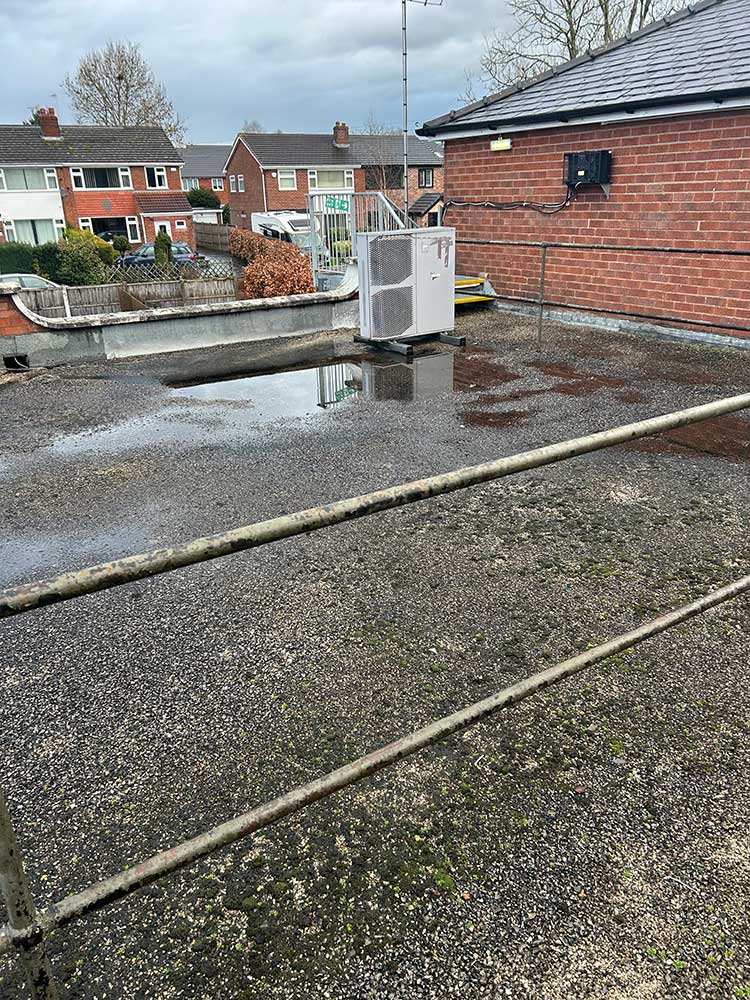
Water is the single biggest threat to any flat commercial roof, and drainage is the system that’s supposed to deal with it. When drainage works properly, it’s invisible — water arrives, flows to an outlet, and leaves. When it doesn’t, the consequences show up everywhere except the drainage system itself: stained ceilings, failed membranes, structural loading issues, and insurance claims that get complicated fast if the underlying cause turns out to be years of standing water rather than a single storm event.
This guide covers the most common commercial roof drainage problems, how to recognise the warning signs before they become expensive, and the range of flat roof ponding water solutions available depending on what’s actually causing the issue.
Why Flat Roofs Are Especially Vulnerable
Pitched roofs shed water quickly by design. Flat and low-slope commercial roofs rely on a much smaller fall — often just a few degrees — to move water toward outlets, gutters, or scuppers. That small margin means drainage problems on flat roofs tend to be more common, less forgiving, and slower to reveal themselves than on pitched roofs, where a blockage usually causes an obvious, immediate overflow.
On a flat roof, the same blockage might just mean water sits quietly for days, doing damage that isn’t visible from ground level at all.
Common Causes of Commercial Roof Drainage Problems
Blocked or Undersized Outlets
Roof outlets and gutters collect leaves, moss, sediment, and debris over time, and on commercial buildings surrounded by trees, agricultural land, or industrial dust, this can happen faster than many facilities teams expect. Outlets can also simply be undersized for the roof area they’re serving, particularly on buildings that have been extended or had additional roof area added without the drainage capacity being reassessed.
Inadequate Falls in the Roof Structure
Every flat roof is built with a designed fall — a slight slope engineered to move water to outlets. Falls can be inadequate from the original design, or can develop over time as insulation settles unevenly, structural deflection occurs, or repairs are carried out without matching the original fall precisely. Once falls are compromised, water finds low points and stays there regardless of how clear the outlets are.
Ponding Water
Ponding — water that remains on the roof surface for more than 48 hours after rainfall — is both a symptom and a cause of further problems. It’s usually a sign of inadequate falls or a settled low spot, but once established, ponding accelerates membrane degradation through prolonged UV and moisture exposure, adds significant dead load to the roof structure, and creates conditions where algae, moss, and vegetation can establish themselves and further block drainage paths.
Structural Settlement and Deflection
Older buildings, or buildings on less stable ground, can experience gradual structural settlement that creates new low points on a roof that drained perfectly well when it was first built. This is a particularly tricky cause to diagnose because it develops slowly and the roof covering itself may show no obvious defect — the problem is the shape of what’s underneath it, not the membrane.
Poor Original Design or Value-Engineered Alterations
Some drainage problems are baked in from the start — outlets positioned without accounting for real-world rainfall intensity, insufficient overflow provision, or a design that was value-engineered down during construction to cut costs. Extensions and refurbishments can compound this further if new roof areas are tied into an existing drainage system that was never sized to handle the additional catchment area.
Warning Signs Facilities Managers Should Watch For
- Visible ponding more than 48 hours after rain — the single clearest sign of a drainage or fall problem, and one that’s easy to check simply by walking the roof the day after rainfall.
- Ceiling stains that appear or worsen after rain, then seem to dry out — often a sign of slow drainage rather than a single leak point, since the water is finding its way through over time rather than pouring in all at once.
- Vegetation, moss, or algae growth on the roof surface, particularly around outlets — a strong indicator that water is sitting somewhere it shouldn’t.
- Visible deflection or sagging in the roof deck when viewed from below in a plant room or open-plan ceiling void.
- Gutters or outlets that overflow visibly during moderate rainfall, not just extreme storms.
- Increased algae or staining on external walls below outlet or overflow points, suggesting the drainage system is being pushed beyond its capacity regularly.
- Rising damp-style staining at low-level internal walls near the roof perimeter, which can indicate water tracking down through the building fabric from a roof-level drainage failure rather than a wall-level issue.
Any of these signs on their own might be minor. Several appearing together, or recurring after previous “repairs,” usually points to a drainage design issue rather than a simple maintenance fix.
Flat Roof Ponding Water Solutions
The right fix depends entirely on the actual cause, which is why a proper survey — rather than a quick patch repair — pays for itself on anything beyond a simple blocked outlet.
Where the Cause Is Blockage or Maintenance
- Scheduled outlet and gutter clearance, ideally tied to a seasonal maintenance calendar rather than reactive call-outs, especially for sites near trees or in areas with high airborne debris.
- Outlet guards and leaf grilles to reduce how quickly outlets reblock after clearance, without restricting flow capacity.
- CCTV drainage surveys for larger or more complex systems, where blockages may sit within pipework rather than at the visible outlet itself.
Where the Cause Is Inadequate Falls or Ponding
- Tapered insulation systems are one of the most effective long-term fixes for ponding, re-profiling the roof surface to create or restore proper falls toward outlets without needing to rebuild the structural deck itself.
- Additional outlets or overflow provision, where the existing drainage points simply aren’t sufficient for the roof area or local rainfall intensity, sometimes required alongside — or instead of — re-profiling.
- Localised packing or firring pieces for smaller, isolated low spots that don’t justify a full tapered insulation scheme.
Where the Cause Is Structural
- Structural assessment and remedial works, where settlement or deflection is significant enough that surface-level fixes won’t resolve the underlying issue.
- Load monitoring, particularly where ponding has been occurring for an extended period and there’s a possibility the additional water load has itself contributed to further deflection — a cycle that needs professional structural input to break safely.
Where the Cause Is Design Capacity
- Full drainage system redesign, typically needed where a building has been extended, where original design was inadequate for current rainfall patterns, or where climate-related increases in rainfall intensity have outpaced what the original system was specified to handle.
- Siphonic drainage systems, an increasingly common solution for larger commercial roofs, using engineered outlets to drive water through smaller-diameter pipework at higher velocity than gravity drainage alone — useful where retrofitting larger conventional pipework isn’t practical.
Why Drainage Problems Matter Beyond the Roof Itself
Persistent drainage problems rarely stay contained to the roof. Ponding water accelerates membrane failure, which leads to leaks. Leaks lead to internal damage, disrupted operations, and insurance claims — claims that can become complicated if an insurer’s assessor concludes the underlying cause was long-standing ponding rather than a sudden event, since that shifts the claim from “storm damage” toward “wear and tear or lack of maintenance,” a distinction that matters enormously for whether a claim is paid in full.
Addressing drainage properly is also, in a very direct sense, a way of protecting the rest of the roof investment — a re-covered roof with an unresolved drainage fault will develop the same problems again, regardless of how good the new membrane is.
The Bottom Line
Commercial roof drainage problems are rarely random — they trace back to a specific, identifiable cause, whether that’s a blocked outlet, an inadequate fall, structural settlement, or a system that was never sized for the building it’s serving. The range of flat roof ponding water solutions available means almost every drainage issue has a proportionate fix, but only if the cause is correctly diagnosed first. If ponding or recurring leaks have become a familiar feature of your roof rather than an occasional nuisance, it’s worth having the drainage properly surveyed before the next repair, rather than after.
If you’re dealing with recurring ponding or drainage issues and want an honest assessment of what’s actually causing them, we’re happy to take a look and talk through the options.