Guttering is one of the least glamorous parts of a commercial roof, and often one of the most neglected — right up until an overflowing valley gutter is pouring water down a shopfront, or a blocked outlet has sent rainwater tracking back under a membrane it was never meant to touch. Understanding the difference between relining and full replacement, and when each is the right call, can save a significant amount of money without compromising on protection.
Why commercial gutters fail earlier than owners expect
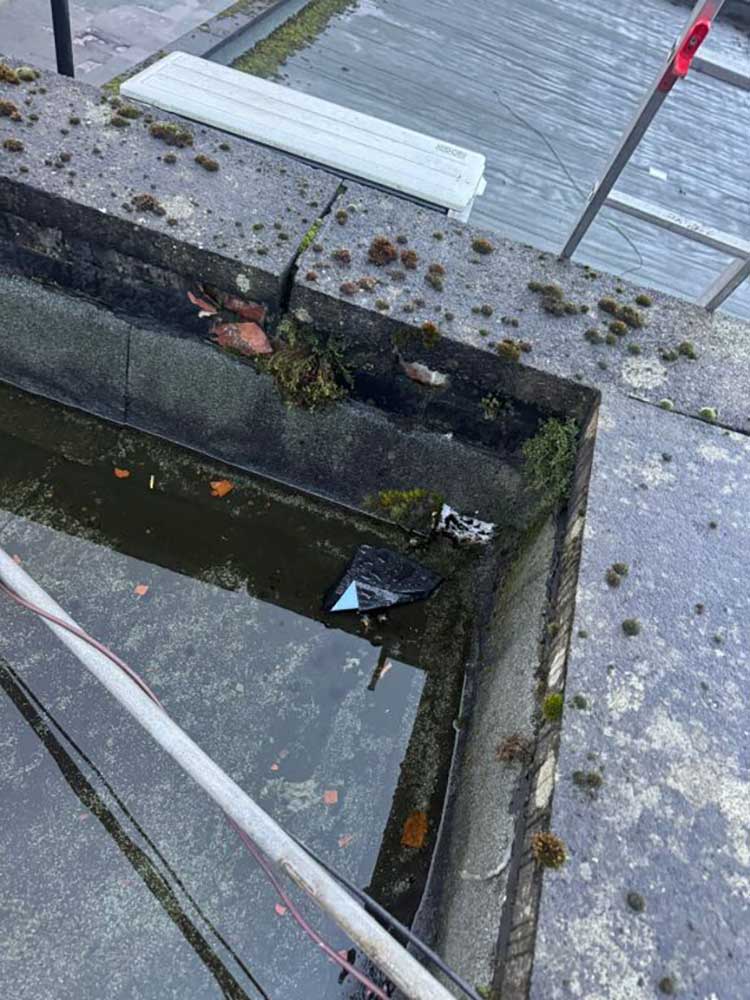
Commercial guttering — particularly on large industrial or retail roofs — carries a disproportionate amount of water compared to a domestic system, often from several roof planes converging into a single valley or box gutter. Combined with UK weather patterns and, in older systems, ageing joints and coatings, it’s common to see corrosion, splitting, or seam failure well before the rest of the roof shows signs of age. Once a gutter starts leaking at a joint or seam, the problem rarely stays contained — water finds its way behind fascias, into wall cavities, or down through roof penetrations nearby.
What relining actually involves
Gutter relining doesn’t mean stripping the system back to bare metal and starting again. Instead, a new waterproof lining — typically a reinforced GRP (fibreglass) or liquid-applied membrane system — is bonded directly over the existing gutter profile, sealing joints, seams, and any minor corrosion in one continuous, seamless layer. Done properly, it restores full weathertightness and can extend the working life of a gutter system by 15–20 years, at a fraction of the cost and disruption of removing and replacing the entire run.
When relining is the right call
Relining works well where the underlying structure of the gutter — the brackets, falls, and profile — is still sound, and the problem is genuinely about the surface: pinholing, failed joint seals, surface corrosion, or a coating that’s simply reached the end of its service life. It’s particularly cost-effective on long runs or box gutters that would be expensive and disruptive to strip out entirely, and on buildings where minimising downtime and access costs matters — retail units that can’t close, hotels with guests in situ, or industrial sites running continuous operations.
When full replacement is the better investment
There comes a point where relining is simply patching a structural problem rather than fixing it. If the gutter has lost its correct fall (the slight gradient that keeps water moving toward outlets) due to sagging brackets or structural movement, no amount of relining will solve standing water — it needs to be rebuilt properly. Similarly, gutters with extensive structural corrosion, significant distortion, or outlets and downpipe connections that are failing structurally are better addressed with full replacement, since relining over a failing substrate simply delays a bigger problem.
Why this isn’t just a maintenance issue
Guttering plays a bigger role in building compliance than most facility managers realise. Persistent overflow or poor drainage can contribute to damp penetration that affects fire compartmentation, insulation performance, and — on buildings with asbestos-containing materials nearby — can accelerate the deterioration of components that are far more expensive to deal with if water ingress speeds up their failure. Insurers increasingly expect evidence of a well-maintained drainage system as part of routine roof upkeep, and a gutter that’s clearly been neglected can complicate a claim if water damage does occur.
Getting an honest assessment
The right answer — reline or replace — genuinely depends on what’s happening underneath the surface, not just what’s visible from ground level. At RMLFS, our gutter relining assessments include a full inspection of falls, brackets, joints, and outlet condition, so the recommendation reflects what the gutter actually needs rather than defaulting to the more expensive option.