Gutters rarely get the attention the rest of a commercial roof does. They’re hidden behind parapets, buried in box sections, or tucked below the roofline where nobody looks unless there’s already water coming through a ceiling. That’s exactly why they’re one of the most common causes of expensive, avoidable damage on commercial buildings — by the time a gutter failure is visible from inside, it’s usually been tracking water into the building fabric for months.
The good news is that most failing commercial gutters don’t need replacing outright. Relining is very often the better option, both financially and operationally. Here’s how the two compare, and how to know which one your building actually needs.
Why commercial gutters fail
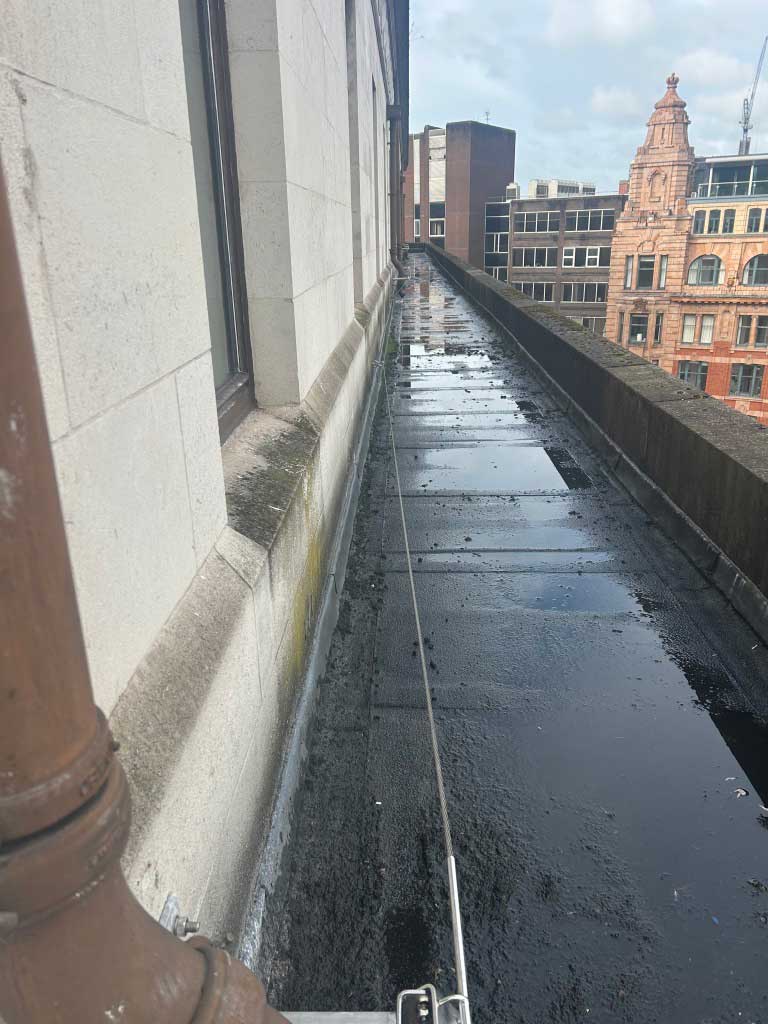
Box gutters, parapet gutters, and valley gutters take a disproportionate amount of punishment for their size. They collect water from a much larger roof area than their own footprint, so flow rates and standing water exposure are high relative to other parts of the roof. The typical failure points are predictable:
- Joints and seams — the sealants used at joints, corners, and stop-ends dry out and crack over time, usually somewhere between 10 and 20 years depending on material and exposure
- Corrosion — metal gutters, particularly steel, corrode where standing water collects between cleanouts or outlets
- Blocked outlets — leaf litter, moss, silt, and nesting material choke outlets, causing water to back up and overflow behind fascias rather than draining away
- Cracking and delamination — older asphalt, felt, or lead-lined gutters split and lift as the lining ages and loses flexibility
Once one joint or section fails, water tracking inside the gutter tends to accelerate deterioration at the next weak point downstream, so a single small leak rarely stays small for long.
What relining actually involves
Gutter relining applies a new, seamless waterproof layer to the inside of the existing gutter channel without removing or replacing the gutter structure itself. The two main systems used commercially are:
- GRP (glass-reinforced plastic) laminate systems, moulded in situ and cured to form a rigid, seamless liner
- Liquid-applied resin systems, typically a fibre-reinforced coating built up in layers with a UV-stable topcoat, which conform easily to complex shapes, corners, and outlets without fabricated joints
Both approaches eliminate the joints and fixing points that cause conventional gutters to fail in the first place — there’s simply nothing left to leak, because the new lining is continuous. Outlets, downpipe connections, and expansion joints are integrated into the liner rather than sealed separately, which removes the weak points a traditional metal or asphalt gutter depends on.
Properly installed, a quality lining system typically carries a guarantee in the region of 20–25 years, and can be applied to steel, aluminium, GRP, lead, asphalt, and concrete substrates alike — so the material of the original gutter is rarely a barrier to relining.
When relining works, and when it doesn’t
Relining is the right call when the underlying gutter structure is sound and the failure is limited to the surface, joints, or lining — which describes the large majority of commercial gutter problems. It’s not disruptive to the building’s operation, doesn’t require the gutter to be dismantled, and is priced by linear metre rather than by the scale of a full roof project, making it significantly cheaper than replacement in most cases.
Full replacement becomes necessary where:
- The gutter structure itself has failed — sagging, structural corrosion through the metal, or rot in the supporting timberwork
- The falls (the gradient that carries water to the outlets) are incorrect or have shifted, causing persistent standing water regardless of lining
- The gutter profile is undersized for current rainfall loading, which occasionally comes up on older buildings where roof area or usage has changed since the gutters were installed
A proper survey before committing to either route is what actually determines this — a gutter that looks bad from below (staining, rust streaks, visible patch repairs) is very often still structurally sound and an excellent relining candidate.
Why this gets missed on bigger projects
One of the more expensive mistakes on commercial roofing projects is treating gutters as an afterthought to the main roof works. A leak that shows up inside a building is often assumed to be a roof membrane failure, and the roof gets re-covered or re-clad — at significant cost — while the actual source, a failed gutter joint, goes untouched and the leak returns. A roof survey that includes the guttering, not just the main covering, avoids this: it’s far cheaper to fix a gutter run than to have paid for a full re-roof that doesn’t solve the problem.
What this means for planning
- Don’t assume replacement is the only fix. Most gutter failures are joint and lining problems, not structural ones, and relining resolves them at a fraction of the cost and disruption.
- Get gutters included in any roof survey, not inspected separately or as an afterthought — leaks attributed to the roof membrane are frequently a gutter problem instead.
- Check for blocked outlets before assuming a leak means failure. Simple clearance can resolve issues that look far more serious.
- Budget for guttering as part of routine roof maintenance, not as an emergency response — a gutter caught early is almost always a relining job; one left too long can become a replacement.
A gutter system that’s quietly failing doesn’t announce itself until the damage is already inside the building. Catching it early — and choosing the right fix rather than the most expensive one — is one of the more straightforward ways to protect a commercial roof’s long-term value.
RMLFS provides gutter relining and full guttering replacement for commercial and industrial properties across the UK, delivered with minimal disruption to site operations. If your gutters are showing signs of leaking or staining, get in touch for a survey.