Water represents the primary threat to commercial roofing systems—not through the occasional dramatic leak that prompts emergency repairs, but through the persistent, insidious damage that accumulates when drainage systems fail to move water off roofs quickly and completely. A properly functioning drainage system removes rainwater within hours of rainfall, maintaining dry membrane surfaces that age slowly and predictably. A compromised drainage system creates ponding where water sits for days or weeks, accelerating membrane degradation, overloading structural elements, creating leak paths at penetrations and details, and transforming routine weather events into maintenance emergencies generating thousands in repair costs.
For facility managers overseeing commercial roofing portfolios—retail properties, hotels, industrial facilities, office buildings—drainage system condition determines whether roofs achieve their designed 25-30 year service lives or require premature replacement at 15-18 years from water-accelerated deterioration. The difference isn’t marginal: inadequate drainage can reduce roof lifespan by 30-40% while increasing annual maintenance costs by £2,000-£8,000 per property from repeated repairs addressing water-related damage. Yet drainage receives insufficient attention in typical maintenance programs, treated as seasonal task—”clear the gutters in autumn”—rather than critical building system requiring systematic inspection, proactive maintenance, and immediate intervention when problems emerge.
Understanding how commercial roof drainage actually works, recognizing the failure modes that create water retention and damage, and implementing inspection and maintenance protocols that keep drainage systems functioning optimally transforms roof management from reactive crisis response to proactive system preservation. The facility manager who ensures water exits roofs quickly protects membrane lifespan, prevents structural damage, avoids emergency repairs, and delivers the decades of reliable performance that justify commercial roofing’s substantial capital investment.
How Commercial Roof Drainage Actually Works
Commercial flat roof drainage differs fundamentally from residential sloped roof systems, relying on carefully designed falls, outlet positioning, and flow capacity rather than natural gravity drainage.
Design falls and slope creation direct water toward drainage points through intentional roof pitch—typically 1:60 to 1:40 (approximately 1-1.5 degrees)—insufficient to be visible but adequate to move water. Modern commercial roofs achieve this fall through tapered insulation systems with factory-manufactured panels that create progressive slope from high points to outlets, or through structural deck design incorporating fall into the building structure itself.
The fall magnitude critically affects drainage performance. Minimum 1:60 fall provides barely adequate water movement under ideal conditions, with small debris or membrane irregularities potentially creating reverse falls that trap water. Preferred 1:40 fall provides more robust drainage with faster water movement and greater tolerance for inevitable deck or insulation irregularities. Roofs specified with inadequate fall or constructed without proper fall due to contractor error face chronic ponding regardless of outlet capacity or maintenance quality.
Outlet types and positioning determine where water exits the roof and influence drainage effectiveness. Internal roof drains—outlets within the roof field connecting to vertical pipes (downpipes) running through the building—represent the most common commercial roof drainage. These outlets typically feature 100-150mm diameter throats, removable strainers or domes preventing debris entry, and sump designs that position the outlet throat below surrounding roof level maximizing water collection.
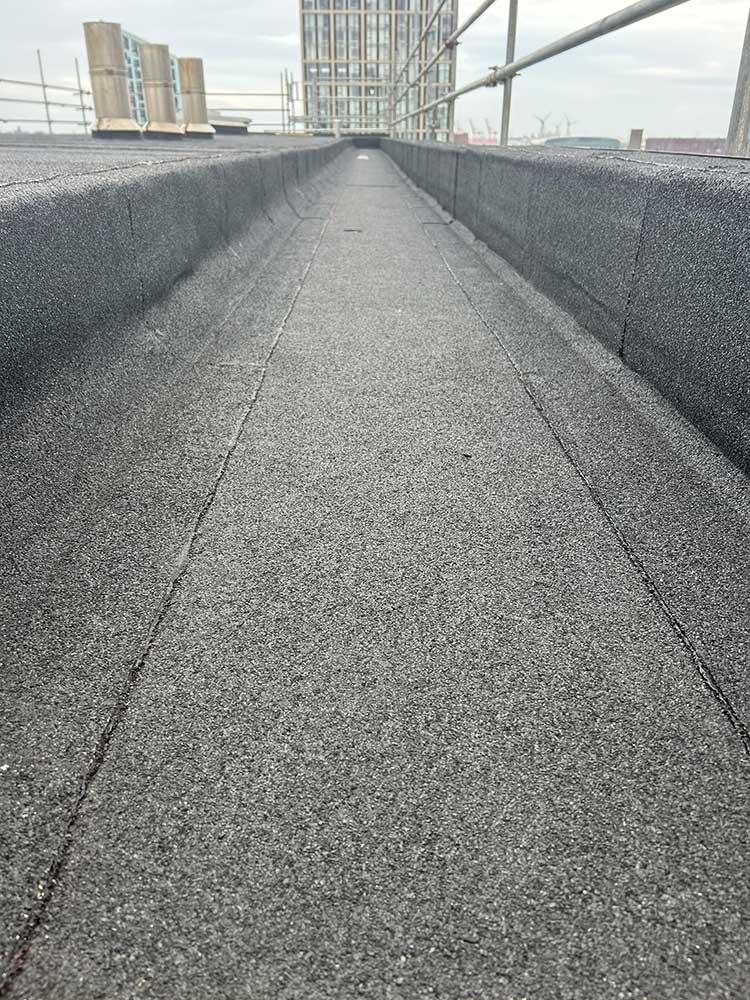
Scuppers—rectangular openings through parapet walls allowing water to exit at roof edges—provide supplementary drainage or serve as secondary overflow drainage activated when primary outlets can’t handle flow. Perimeter gutters collecting water from roof edges then channeling it to downpipes suit certain building configurations, particularly those with shallow parapets or architectural preferences for edge drainage over internal outlets.
Outlet positioning should concentrate at true low points in the drainage design—the locations where tapered falls converge and water naturally accumulates. Outlets positioned away from actual low points leave residual water on roofs even after drainage flow ceases. Multiple outlets per drainage area provide redundancy—if one outlet clogs, others continue functioning preventing catastrophic water accumulation.
Drainage capacity calculations size outlet quantities and dimensions to handle design rainfall intensity—typically 1-in-20-year or 1-in-50-year storm events depending on building importance and local requirements. UK design rainfall has increased with climate change, with many existing roofs originally designed to older, less intense rainfall data now facing undersized drainage during contemporary storm events.
The capacity calculation accounts for roof area draining to each outlet, design rainfall intensity (typically 75-100mm/hour for UK 1-in-20-year events in most regions), and outlet hydraulic characteristics. Undersized drainage manifests during intense rainfall when roofs flood with water depths exceeding outlet capacity to drain quickly, creating temporary ponding that should dissipate within hours but reveals drainage inadequacy.
Secondary (overflow) drainage provides emergency water removal if primary drainage fails or becomes overwhelmed. Building regulations require secondary drainage preventing catastrophic roof loading if primary drainage clogs or proves inadequate. This typically consists of scuppers set 50-75mm above primary outlet level, activating when water depth exceeds normal drainage capacity but before structural loading becomes dangerous.
Secondary drainage often discharges to uncontrolled locations—over building edges onto paving or landscaping—since it’s intended as emergency overflow rather than primary designed drainage. However, frequent secondary drainage activation indicates primary drainage inadequacy requiring investigation and correction.
Water flow paths and membrane details between where rain falls and outlets lies affect drainage effectiveness. Long flow paths across rough membranes create friction slowing water movement. Penetrations, equipment pads, and roof details creating obstacles divert flow or create trapped areas where water can’t reach outlets despite adequate slope.
Well-designed drainage considers the entire roof surface as drainage basin with flow paths from all areas reaching outlets efficiently. Poorly designed systems create isolated low areas, flow obstacles, or reverse falls that trap water despite adequate outlets and overall slope.
Understanding these drainage system components reveals why drainage failure isn’t simply clogged outlets—it’s systemic inadequacy arising from insufficient fall, poorly positioned outlets, undersized capacity, absent secondary drainage, or flow path obstructions. Addressing drainage problems often requires correcting design deficiencies rather than just improving maintenance.
Common Drainage Failures and Their Consequences
Drainage systems fail through multiple mechanisms, each creating distinct damage patterns that compound if not addressed promptly.
Blocked outlets and strainers represent the most obvious and common failure mode. Leaves, debris, moss, and sediment accumulate at outlet strainers, reducing or eliminating flow capacity. Partially blocked outlets still drain but slowly, creating extended ponding periods after rainfall. Completely blocked outlets prevent drainage entirely until water rises to secondary overflow level or overtops parapets.
The blockage typically develops gradually—small debris accumulation initially slows flow marginally, then accelerates as trapped debris catches additional material. What began as 10% flow reduction becomes 50% then 90% blockage over weeks or months without intervention. Facilities relying on “the rain will wash it clear” discover this rarely works—debris tends to compact and consolidate rather than wash away.
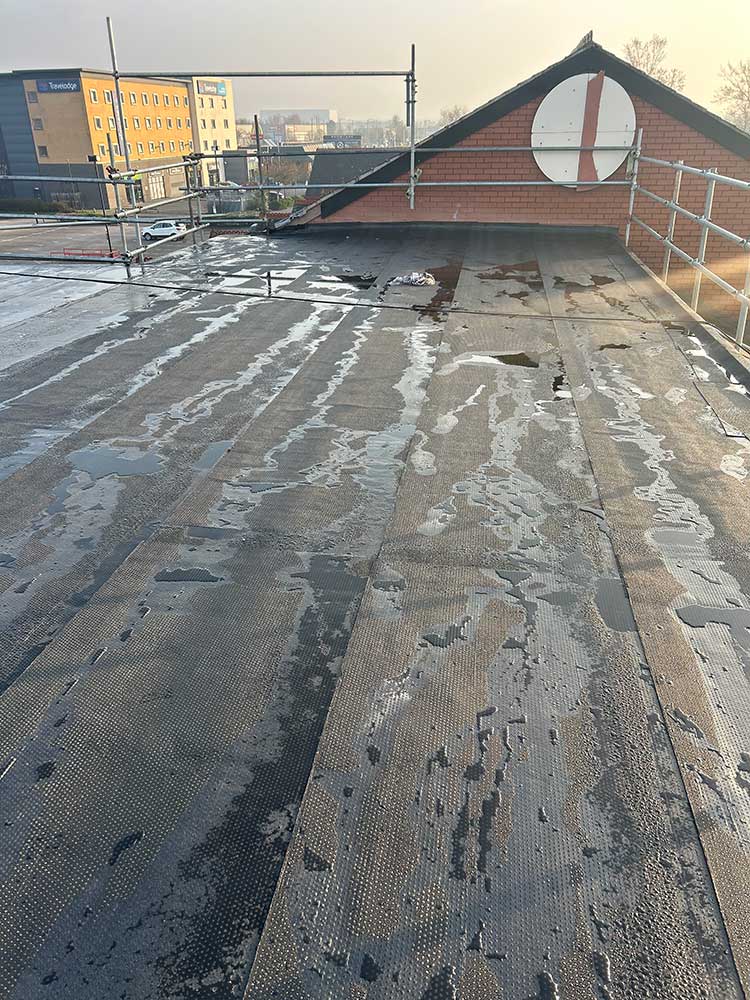
Ponding and standing water from inadequate slope, blocked drainage, or structural settlement creates concentrated membrane degradation. Water standing more than 48 hours after rainfall qualifies as ponding, indicating drainage deficiency requiring attention. The damage mechanisms include UV degradation acceleration—water acts as magnifying glass intensifying UV exposure of submerged membrane; biological growth—algae and moss thrive in persistent moisture; freeze-thaw damage—standing water freezes creating ice expansion stresses; and accelerated material degradation—all membrane materials age faster under continuous water exposure than dry conditions.
Ponding locations become self-perpetuating as membrane degrades—initial shallow ponding causes localized membrane thinning, creating depression that holds deeper water, accelerating degradation further until leak develops. A roof that initially had minor ponding from inadequate fall develops deeper ponding over years as membranes compress and degrade, progressively worsening until replacement becomes necessary.
Gutter overflow and fascia damage when perimeter gutters exceed capacity results from undersized gutters, blocked outlets, or inadequate falls within the gutter itself. Overflowing water cascades over fascias and building facades, causing water damage to building fabric, staining external finishes, eroding mortar joints, and potentially entering building through windows or wall penetrations.
Repeated overflow creates progressive damage—initial minor staining becomes significant facade deterioration, minor mortar erosion becomes structural masonry damage, and occasional dampness becomes chronic water infiltration. The repair costs for facade and structural damage often exceed roof drainage repair costs by factors of five to ten.
Ice dam formation in cold weather when inadequate drainage leaves water that freezes creates ice accumulation preventing subsequent snowmelt drainage. As snow melts, water flows under ice dams seeking drainage routes, often finding paths through roof membrane laps, flashing details, or penetrations that would resist vertical rainfall but fail under sustained water pressure.
Ice dams also add weight loading—a roof with 100mm of standing water that freezes carries approximately 100 kg/m² load in addition to any snow loading. Roofs designed to minimum dead load and snow load specifications may experience overstress from ice accumulation in drainage areas, potentially causing structural damage or even collapse in extreme cases.
Membrane stress at trapped water locations creates mechanical damage beyond weathering effects. Trapped water expands under freeze-thaw cycling, stressing membrane attachments and details. Temperature cycling creates differential expansion between water-covered membrane (temperature buffered by water) and exposed membrane (experiencing full temperature swings), stressing membrane at ponding perimeters.
Mechanically attached membranes experience increased fastener stress as water weight creates localized loading. Over thousands of loading cycles, fasteners back out, pull through membrane, or fatigue the deck attachment, eventually allowing membrane movement and edge lifting that propagates across entire roof sections.
Structural damage from sustained overload occurs when drainage failure allows water accumulation exceeding design loading. A commercial roof designed for 40 kg/m² dead load plus 60 kg/m² live load (100 kg/m² total) faces overstress when 200mm of trapped water adds 200 kg/m² loading—double design capacity. Sustained overload causes deck deflection, structural member overstress, connection failures, and potential collapse risk.
While catastrophic collapse is rare in UK construction, progressive structural damage is common—sagging visible as dish-shaped depressions, cracked or deformed deck panels, stressed or failed connections, and permanent deformation that remains even after water drains. This structural damage creates future drainage problems as deformations become new low spots trapping water in perpetual cycle.
Interior water damage from leaks represents the visible consequence getting management attention, but by the time leaks manifest internally, roof damage is substantial. Water finding entry through deteriorated membranes, failed details, or stressed penetrations damages ceilings, interior finishes, stock, equipment, and building contents. A single significant leak event can cause £5,000-£50,000+ interior damage depending on building use and affected areas.
The liability extends beyond direct damage to business interruption—retail lost sales during leak remediation, hotel guest relocations and negative reviews, industrial production disruptions, office productivity losses from workspace unavailability. These consequential costs often exceed direct repair costs substantially.
Understanding these failure modes reveals why drainage maintenance isn’t optional nice-to-have but rather critical protection against damage costs worth thousands to hundreds of thousands annually. The facility manager who prevents drainage failures through proactive maintenance avoids these consequences; the manager who treats drainage as minor concern discovers its importance too late when expensive remediation becomes necessary.
Routine Inspection Protocols for Drainage Systems
Systematic drainage inspection programs identify problems while still minor and correctable through straightforward maintenance rather than expensive repairs.
Quarterly visual inspections provide baseline surveillance sufficient for most commercial properties without exceptional drainage challenges. These inspections should occur following each season’s weather patterns—post-winter inspecting for ice damage, spring checking for winter debris accumulation, post-summer verifying outlet function and biological growth, autumn preparing for wet season by clearing leaves and debris.
The inspection covers: all outlets checking for blockage, debris accumulation, strainer damage, or flow restrictions; gutter systems examining for debris, vegetation growth, sag or misalignment; roof surfaces identifying ponding areas, membrane deterioration at drainage paths, debris accumulation; and scuppers and overflow drainage verifying clear function and proper positioning. Time investment is modest—30-60 minutes for typical commercial roofs—but the problem identification justifies the effort many times over.
Post-storm inspections after significant rainfall events verify drainage performed adequately during actual demand. Walk the roof within 24 hours after heavy rain (50mm+ precipitation or sustained rainfall) observing water behavior. Ideally, minimal standing water remains 24 hours post-storm with complete drainage within 48 hours. Standing water beyond this indicates drainage inadequacy requiring investigation.
Post-storm inspection identifies problem areas that periodic inspections might miss—low spots only evident when full of water, inadequate falls revealed by flow patterns, outlet capacity limitations exposed during high-flow conditions, and overflow activation showing primary drainage inadequacy. These observations inform maintenance priorities and capital planning for drainage improvements.
Detailed annual inspection by qualified roofing professionals provides comprehensive assessment beyond facilities staff capability. This inspection should include: drainage flow testing with hoses simulating heavy rainfall verifying outlet function and adequate flow capacity; membrane condition assessment at drainage areas checking for ponding-accelerated degradation; structural evaluation at chronic ponding locations inspecting for deck deflection or damage; and photographic documentation creating baseline for tracking condition changes.
Annual professional inspection typically costs £400-£800 depending on roof size and complexity—modest investment providing expert assessment and documentation for maintenance planning and warranty compliance.
Flow testing procedures actively verify drainage function rather than relying on visual assessment. Using fire hoses or bulk water delivery, flood roof areas observing water flow to outlets, measuring time for water to drain, identifying areas where flow is slow or absent, and noting any backup or outlet inadequacy. This active testing reveals problems that appear adequate during casual observation but prove insufficient under actual flow conditions.
Flow testing should concentrate on problem-prone areas—perimeter zones where parapets create deep gutters, roof areas with known low spots, sections with complex geometry or numerous penetrations, and any locations where previous ponding was observed. The test volume should approximate heavy rainfall—50-75mm equivalent (50-75 litres per square meter) creates realistic loading enabling meaningful observations.
Thermographic survey using infrared imaging identifies wet areas within roof assemblies before leaks become visible internally. Drainage problems often create moisture infiltration that saturates insulation or deck materials without immediate internal leakage. Thermal imaging conducted under appropriate weather conditions (typically clear mornings after overnight cooling) shows temperature differentials between dry and wet assemblies, enabling targeted repair before moisture causes extensive damage.
While thermal surveys require specialized equipment and expertise (costs typically £800-£2,000 for commercial properties), they reveal hidden water damage that visual inspection misses. Surveys are particularly valuable on large commercial roofs where drainage problems might affect isolated areas not evident from cursory inspection.
Record keeping and trending transforms individual inspection observations into longitudinal understanding of drainage system condition. Maintain logs documenting inspection dates, findings, corrective actions, and costs enabling pattern recognition. A drainage area requiring clearing quarterly indicates chronic debris accumulation problem; ponding locations that persist despite clearing suggest structural or design inadequacy; and outlet blockage acceleration suggests upstream debris source needing attention.
Digital documentation with geotagged photographs, drone imagery for large roofs, and integration with facilities management software enables sophisticated tracking unavailable with paper records. The facility manager who can query “show me all ponding locations identified over the past two years” and receive mapped results manages drainage strategically; the manager with scattered paper notes manages reactively.
Proactive Maintenance: Prevention vs. Repair
Systematic maintenance preserving drainage function costs a fraction of repair expenses addressing damage from drainage failures.
Seasonal gutter and outlet cleaning represents the most fundamental and cost-effective drainage maintenance. Autumn cleaning removes fallen leaves before they clog outlets and gutters through winter. Spring cleaning addresses winter debris accumulation and biological growth beginning to establish. The cleaning should be thorough—remove all debris from gutters, clear all outlet strainers, flush downpipes verifying complete clearance, and dispose of collected material properly.
For commercial properties with surrounding trees or vegetation, quarterly cleaning may be necessary preventing debris accumulation between seasonal services. The cost—typically £300-£600 per cleaning for medium commercial roofs—is modest insurance against drainage failure consequences worth thousands.
Biological growth control through periodic treatment prevents moss, algae, and lichen establishment that clogs drainage, retains moisture, and accelerates membrane degradation. Biocide treatments applied annually or bi-annually to roof surfaces, gutters, and persistent growth areas suppress biological colonization. The treatments are most effective applied in spring before growth accelerates, with reapplication in autumn extending protection through wet winter months.
Biological growth indicates chronic moisture—moss doesn’t establish on roofs that dry quickly after rainfall. Treating growth provides temporary relief, but addressing underlying drainage problems preventing rapid drying provides long-term solution. Roofs requiring frequent biocide treatment benefit from drainage assessment identifying why persistent moisture enables growth.
Minor slope corrections using tapered insulation or roof build-up adjustments address isolated low spots causing localized ponding. Small depressions can be filled with additional insulation crickets or membrane build-up creating positive drainage toward outlets. These corrections cost £500-£2,000 per location—far less than membrane replacement or structural repairs that become necessary if ponding continues damaging membrane and deck.
However, widespread ponding indicates systemic design inadequacy requiring comprehensive drainage redesign rather than piecemeal corrections. Attempting to patch poor design with multiple small corrections often proves less effective and more expensive than proper re-sloping or additional outlet installation.
Outlet and strainer upgrades improve drainage capacity where original design proves inadequate for current conditions (climate change rainfall, building additions affecting drainage, or original undersizing). Replacing standard 100mm outlets with 150mm outlets increases capacity substantially, installing higher-flow strainer designs reduces blockage frequency, and adding supplementary outlets in areas with inadequate coverage improves overall drainage.
Outlet upgrade costs typically run £800-£2,500 per outlet installed including membrane work, strainer, downpipe connection, and finishing—reasonable investment improving drainage permanently rather than relying on increased maintenance frequency compensating for inadequate capacity.
Gutter repairs and resizing address deteriorated or inadequate perimeter drainage. Leaking gutter joints, corroded gutter bottoms, or sagging sections require repair or replacement preventing overflow and facade damage. Undersized gutters benefit from replacement with larger sections or supplementary downpipes reducing loading on existing capacity.
Modern gutter replacement often incorporates gutter lining systems—liquid membranes or preformed liners installed within existing gutters creating seamless waterproofing without complete gutter removal. These systems cost less than full replacement (£40-£80 per linear meter vs. £100-£200 for replacement) while extending gutter service life 15-20 years.
Preventive membrane repairs at drainage areas showing early degradation from past ponding prevent minor problems becoming major failures. Membrane patches over areas showing surface crazing, small cracks, or loss of granules cost £150-£500 per repair area—straightforward preventive maintenance. Ignoring these early warning signs leads to membrane failure requiring extensive repairs or premature replacement costing thousands.
The preventive maintenance philosophy recognizes that drainage problems rarely fix themselves—they progressively worsen until intervention becomes necessary. Early intervention through routine maintenance costs less, causes less disruption, and delivers better outcomes than delayed intervention after serious damage develops.
When to Consider Drainage System Upgrades
Some drainage problems require capital investment in system improvements rather than increased maintenance addressing symptoms of inadequate design.
Chronic ponding despite maintenance indicates design inadequacy rather than maintenance failure. If outlets are clear, debris is removed promptly, and water still stands for days after rainfall, the problem is insufficient fall, inadequate outlet capacity, or poor outlet positioning. Continuing to simply maintain an inadequate system wastes resources without solving the underlying problem.
The solution requires drainage assessment by qualified roofing consultant or engineer identifying specific deficiencies. This might reveal insufficient slope necessitating tapered insulation installation, inadequate outlet quantity requiring additional drains, or structural settlement creating reverse falls needing correction. The assessment costs £1,000-£3,000 but identifies problems clearly enabling informed capital investment in effective solutions.
Frequent overflow activation where secondary drainage operates regularly rather than rarely during extreme events signals primary drainage inadequacy. Design intent is that overflow drainage activates only during storms exceeding design capacity—perhaps once or twice annually. Monthly or more frequent activation indicates primary drainage can’t handle typical UK rainfall, requiring capacity upgrades.
Additional outlets are typically most cost-effective solution, though gutter upsizing or improved roof falls might be necessary depending on specific inadequacy. The investment—£5,000-£15,000 for outlet additions including membrane work and downpipe extensions—prevents facade damage and membrane stress worth far more than the upgrade cost.
Structural damage from water loading including visible sagging, deck deflection, or permanent deformation requires immediate drainage improvement preventing progressive damage. Once structural elements experience overstress from water loading, the damage doesn’t reverse—it persists and potentially worsens with subsequent loading cycles.
Structural assessment determines whether damage is cosmetic or affects building safety. Minor cosmetic sagging might be acceptable with drainage improvement preventing worsening. Significant deflection affecting structural integrity may require deck repairs or reinforcement alongside drainage upgrades—expensive but necessary to prevent progressive failure.
Climate change adaptation addresses increasing rainfall intensity from climate change making historically adequate drainage marginal or inadequate under contemporary weather patterns. UK rainfall data shows increased intensity and frequency of extreme events compared to historical design standards. Roofs designed to 1980s or 1990s rainfall data experience overwhelmed drainage during storms that meet current design criteria but exceed historical standards.
Proactive drainage capacity upgrades before failures occur costs less than reactive repairs after damage manifests. Facilities with long-term ownership horizons benefit from upgrading drainage to contemporary standards even on older roofs not experiencing immediate problems, future-proofing against continuing climate trend toward more intense rainfall.
Major roof refurbishment opportunities provide economical timing for drainage upgrades that would be expensive as standalone projects. When membrane replacement, insulation upgrade, or other major roof work proceeds, incorporating drainage improvements adds incremental cost far below standalone upgrade expenses. Tapered insulation installed during roof replacement adds perhaps 15-20% to total cost; installed as separate project it might cost 50-60% of original roof cost given mobilization, membrane disturbance, and finishing work required.
Strategic capital planning identifies upcoming major roof work enabling drainage upgrade integration. The facility manager who understands that roof replacement scheduled for 2027 can economically incorporate long-needed drainage improvements plans accordingly, while the manager treating each issue independently misses cost-effective bundling opportunities.
Regulatory or insurance requirements sometimes mandate drainage improvements regardless of current performance. Building regulation changes might require upgraded secondary drainage, insurance inspections might identify drainage inadequacy as coverage condition, or sale/refinancing might reveal drainage deficiencies requiring correction.
These requirements create non-discretionary capital needs distinct from performance-driven upgrades. However, they often identify genuine problems that would eventually require attention, making mandated improvements valuable building upgrades rather than pure compliance burdens.
The upgrade decision involves analyzing whether ongoing maintenance and repair costs addressing inadequate drainage exceed upgrade investment amortized over remaining roof life. If a roof faces 10 years of £2,000 annual drainage-related repairs, the £15,000 upgrade providing permanent solution proves economical. If problems are minor and infrequent, continuing maintenance may be more cost-effective than major capital investment.
Drainage Integration with Overall Roof Management
Effective drainage management integrates with comprehensive roof asset management rather than operating as isolated concern.
Warranty compliance often requires drainage maintenance as coverage condition. Manufacturer warranties typically exclude ponding damage—standing water beyond 48 hours voids coverage regardless of whether membrane fails. Maintaining clear documentation of drainage maintenance, addressing ponding promptly, and implementing drainage improvements where chronic ponding exists protects warranty validity.
If ponding occurs despite maintenance, documenting the problem, contractor responses, and improvement efforts demonstrates good-faith compliance even if ponding persists from design inadequacy rather than maintenance neglect. This documentation proves critical if warranty claims arise addressing apparent ponding-related damage.
Capital planning linkage connects drainage system condition with roof replacement timing decisions. A roof with adequate drainage achieving full service life justifies deferred replacement and continued maintenance. A roof with chronic drainage problems accelerating membrane deterioration argues for earlier replacement incorporating proper drainage design rather than continuing to invest in doomed system.
The facility manager who understands this connection makes informed capital decisions—recognizing when drainage problems will inevitably drive premature roof replacement versus when drainage improvements enable full service life extension. This strategic perspective optimizes capital deployment across roofing portfolios.
Energy efficiency coordination recognizes that drainage improvements requiring insulation work present opportunities for thermal performance upgrades. Tapered insulation addressing drainage deficiencies can incorporate enhanced R-values simultaneously improving drainage and energy performance. The incremental cost for better insulation while already installing tapered system is modest compared to separate energy upgrade project costs.
Sustainability objectives benefit from effective drainage reducing roof lifecycle costs and extending membrane service life. Roofs lasting 30 years rather than failing at 20 from drainage problems avoid premature replacement reducing embodied carbon and waste generation. Stormwater management through adequate drainage prevents erosion, reduces combined sewer overflow impacts, and protects downstream water quality.
Building systems coordination addresses interactions between drainage and other building systems—HVAC equipment on roofs affecting drainage patterns, solar panel installations creating shading and water channeling effects, green roof drainage requirements, and rooftop amenity space water management. Comprehensive facilities management recognizes these interdependencies rather than optimizing each system in isolation.
Portfolio-level management for owners with multiple properties identifies common drainage problems, optimizes maintenance contractor relationships across properties, develops standardized inspection protocols, and shares successful solutions across sites. Portfolio insights reveal patterns—certain building types or roof configurations experiencing systematic drainage challenges, specific contractors delivering superior maintenance quality, or drainage upgrade ROI calculations informing investment decisions across the portfolio.
The integrated approach treats drainage as critical subsystem within overall roof asset management, receiving systematic attention, adequate investment, and strategic consideration rather than being relegated to reactive maintenance only addressing problems after they manifest as leaks or visible damage.
Conclusion: Drainage as Roof Protection Infrastructure
Commercial roof drainage systems represent critical infrastructure deserving equal attention to waterproofing membranes despite receiving far less consideration in typical maintenance programs. The reality is that drainage function determines whether waterproofing membranes achieve designed service lives or fail prematurely—the best membrane installed on a roof with inadequate drainage will perform poorly and fail early, while adequate membranes on roofs with excellent drainage deliver decades of reliable service.
For facility managers overseeing commercial properties, this understanding should fundamentally shape roof management priorities. Drainage maintenance isn’t the seasonal chore addressed when someone remembers to schedule gutter cleaning—it’s systematic program requiring quarterly inspection, proactive maintenance, immediate problem response, and strategic capital investment addressing design inadequacies. The facility manager who maintains excellent drainage function protects hundreds of thousands in roof capital investment while avoiding thousands annually in drainage-related repairs and premature replacements.
The mathematics favor drainage investment unambiguously. Annual inspection and maintenance costing £1,000-£3,000 prevents drainage failures causing £5,000-£50,000 damage events and extends roof service life worth £100,000-£300,000+ in deferred replacement costs. The ROI on drainage maintenance exceeds virtually any other building system maintenance—returns of 5:1 or 10:1 are common, with extreme cases where single prevented failure event justifies years of maintenance investment.
Yet drainage receives inadequate attention in many commercial facilities programs, treated as minor concern unworthy of systematic management. This disconnect between drainage’s actual importance and the attention it receives in practice creates substantial opportunities for facility managers who recognize drainage as strategic roof protection rather than routine maintenance. The properties with systematic drainage programs—quarterly inspections, proactive maintenance, adequate capital investment—outperform properties where drainage receives only reactive attention when problems become acute.
Looking forward, climate change trends toward more intense rainfall events make drainage capacity and function increasingly critical. Roofs designed to historical rainfall data face marginal or inadequate capacity under contemporary and future weather patterns. Proactive capacity assessment and strategic upgrades position commercial properties for continued drainage effectiveness rather than waiting for capacity inadequacy to manifest through failures during severe storm events.
The path forward requires facility managers to elevate drainage from maintenance task to asset management priority, implementing systematic inspection programs capturing drainage condition comprehensively, budgeting adequate resources for both routine maintenance and strategic upgrades, engaging qualified professionals for assessment and complex interventions, and maintaining thorough documentation supporting warranty compliance and capital planning.
For commercial roofing portfolios, the drainage management framework should include quarterly visual inspections by facilities staff, annual professional drainage assessments, immediate response to identified problems rather than deferred correction, capital planning integrating drainage improvement opportunities with major roof work, and documentation systems tracking drainage condition, maintenance activities, and capital investments over roof service life.
The roof that keeps water out matters less than you think if the roof that moves water away fails its function. Standing water defeats even premium waterproofing eventually, while effective drainage protects adequate waterproofing for decades. Prioritize drainage management accordingly—invest the modest resources required for excellent drainage function, and the commercial roofs you manage will deliver the decades of reliable service their capital costs justify, while avoiding the expensive failures that plague properties where drainage receives insufficient attention until problems force reactive interventions costing far more than proactive management would have required.