The commercial roof requiring repair or replacement presents facility managers with a fundamental tension: the work must happen to protect the building and its occupants, yet the process inevitably creates disruption, safety concerns, and operational impacts that affect business continuity. A retail property conducting roof replacement during peak trading season risks lost sales from reduced customer access and construction noise. A hotel undergoing maintenance faces guest complaints about early morning activity and restricted amenity access. An industrial facility dealing with emergency roof repairs confronts production disruption and safety coordination challenges with operating machinery below roof work areas. The difference between roof work that proceeds smoothly with minimal business impact and projects that generate complaints, safety incidents, and operational losses lies entirely in planning that anticipates disruption points, implements mitigation strategies, and maintains clear communication with all affected parties throughout the work period.
For facility managers and property owners overseeing commercial buildings where business operations continue during roofing work—which represents the vast majority of commercial roof projects—effective disruption management isn’t optional enhancement to project specifications. It’s fundamental to project success, often mattering more to building occupants and stakeholders than technical roofing quality that they never directly observe. The roof completed on time and to specification but generating sustained tenant complaints, safety incidents, or measurable operational losses represents project failure despite meeting technical requirements. Conversely, roof work that proceeds unobtrusively, maintains safety rigorously, and minimizes operational impact receives recognition and appreciation even when minor technical imperfections exist.
Understanding Disruption Categories and Business Impact
Roof work affects occupied commercial buildings across multiple dimensions, each requiring distinct mitigation approaches.
Access restrictions from equipment, materials, and safety perimeters limit building entry and exit, affect parking availability, restrict loading dock access, and prevent use of roof-accessed amenities like rooftop terraces or equipment rooms. A retail property with scaffolding blocking the main entrance during refurbishment sees customer traffic decline 15-30% even with alternative access available—customers perceive the building as “under construction” and avoid it. Hotels with roof work above guest room windows face booking impacts from guests avoiding construction-adjacent rooms.
The access impact extends beyond physical barriers to psychological barriers where customers, guests, or employees perceive the building as disrupted even when actual access remains functional. Clear signage, maintained alternative access routes, and communication about temporary changes mitigate but don’t eliminate these perceptions. Some access impact is unavoidable, making project timing around low-demand periods when possible valuable risk reduction.
Noise and vibration from roof work creates perhaps the most common complaint source. Tear-off of existing roofing involves mechanical removal generating sustained noise at 80-95 dB—approaching or exceeding noise levels requiring hearing protection for workers. This noise penetrates through ceiling assemblies affecting spaces below, particularly in lightweight roof construction common in commercial buildings. Standing seam metal installation, fastener driving through concrete decks, and general construction activity create intermittent but disruptive noise throughout work days.
The noise impact varies dramatically by building type and use. Industrial facilities with existing high ambient noise tolerate roof work noise with minimal impact. Quiet office environments find roof work noise highly disruptive to productivity. Hotels face acute sensitivity where guest satisfaction directly correlates with sleep quality—early morning roof work generates immediate complaints and negative reviews. Retail properties experience noise affecting customer shopping experience though tolerance is higher than office or hotel environments.
Dust and debris from tear-off, cutting operations, and general construction activity affects building cleanliness, triggers HVAC system contamination, and creates housekeeping burdens. Roof work generates substantial particulate matter that infiltrates buildings through HVAC systems, open windows, and any penetrations between roof and occupied spaces. This contamination affects sensitive environments—data centers, medical facilities, food preparation areas—more severely than general office or retail spaces.
Dust management through containment, negative pressure, and filtration reduces but doesn’t eliminate debris generation. Buildings with inadequate separation between roof and occupied spaces face persistent dust infiltration regardless of contractor diligence. Some building types—warehouses, manufacturing facilities—tolerate dust better than clean environments like laboratories or medical facilities requiring sterile conditions.
Odors and fumes from hot bitumen application, adhesives, sealants, and coating products affect indoor air quality and generate complaints even when ventilation prevents hazardous concentrations. The distinctive smell of roofing work—particularly built-up felt or liquid applied systems—permeates buildings, creating occupant discomfort and health concerns even when actual air quality remains safe.
Odor sensitivity varies widely—some individuals tolerate construction odors without concern while others experience headaches, nausea, or respiratory irritation at low exposure levels. Modern low-VOC products reduce but don’t eliminate odors, and some building types—particularly hotels and medical facilities—face acute sensitivity where any noticeable odor generates complaints.
Safety hazards from working above occupied spaces, material storage and movement, equipment operation, and general construction activity create liability exposures and operational concerns. Falling debris, dropped tools, or material dislodgement from roof work poses injury risks to building occupants, vehicles, and passing pedestrians. Hot work for torch-applied systems creates fire risk. Chemical exposure from roofing materials affects indoor air quality.
The safety dimension often receives inadequate attention during planning, emerging as crisis management when incidents occur rather than prevented through proactive planning. One dropped tool penetrating a roof assembly and injuring an occupant generates more project impact than weeks of successfully completed work, making safety management paramount.
Operational disruptions specific to building type affect business continuity beyond general construction impacts. Retail properties face customer traffic reduction and sales impacts. Hotels experience guest complaints and booking challenges. Office buildings see productivity losses from noise and distraction. Industrial facilities confront production interference, safety coordination with ongoing operations, and potential shutdown requirements during critical work phases.
Understanding these disruption categories and their business-specific impacts enables facility managers to prioritize mitigation strategies addressing the most significant concerns for their particular building type and operations.
Pre-Project Planning: Setting Up for Success
Effective disruption management begins weeks or months before roof work commences, with planning decisions that shape project execution and impact levels.
Project timing optimization around business cycles, occupancy patterns, and weather windows minimizes impact through strategic scheduling. Retail properties should schedule major roof work outside peak trading seasons—avoiding November-December Christmas period and summer holiday peaks. Hotels time work around occupancy patterns, undertaking disruptive work during low-occupancy periods while deferring work near high-demand dates. Industrial facilities coordinate with production schedules, aligning roof work with planned shutdowns or low-production periods. Office buildings favor summer timing when holiday absence reduces occupancy and open windows provide ventilation alternatives if interior air quality is affected.
Weather considerations in UK context means summer work proceeds faster with fewer weather delays, reducing total disruption duration despite higher contractor demand and costs. Winter work extends timelines from weather interruptions, creating longer disruption periods even though daily productivity might be adequate during workable days. For projects where disruption duration matters more than cost, premium summer scheduling justifies higher contractor rates through faster completion.
Phasing strategies break large roof areas into sections enabling sequential work that maintains operational building areas while work proceeds in isolated zones. A 5,000m² retail warehouse roof might be divided into 5 x 1,000m² phases, completing each before starting the next rather than simultaneous work across the entire roof. This phasing reduces daily impact—fewer workers, less equipment, smaller work areas—while extending total project duration.
Phasing particularly benefits buildings where roof work above specific areas must avoid disrupting critical operations below. Completing work above storage areas before progressing to areas above sales floor, or finishing non-guest areas before guest corridors in hotels, allows business operations to adapt to work progression rather than facing simultaneous disruption everywhere.
Contractor selection criteria should weight disruption management competence alongside technical roofing expertise. Request references specifically addressing contractor performance on occupied buildings, ask about experience with your building type, inquire about safety management systems and track record, and assess communication capabilities and responsiveness. The technically excellent contractor who ignores disruption management creates more project problems than adequate contractor who proactively manages business impacts.
Interview contractor personnel who’ll actually manage on-site work, not just sales representatives who disappear after contract signing. The site supervisor’s communication skills, problem-solving approach, and attitude toward minimizing disruption determines daily project reality more than corporate capabilities.
Occupant communication planning establishes how tenants, guests, staff, and customers will be informed about project timeline, expected impacts, and progress updates. Develop communication plan covering: initial notification 4-6 weeks before work begins explaining project scope and expected impacts; weekly updates during work describing upcoming activities and any schedule changes; incident notification protocols for unplanned disruptions; completion notification and post-project follow-up.
Communication channels should match building type and audience—tenant portal and email for office buildings, guest room notices and front desk briefings for hotels, staff meetings and signage for industrial facilities, customer signage and website updates for retail properties. Multiple channels ensure message reaches diverse audiences through their preferred information sources.
Temporary protection and mitigation measures specified upfront rather than implemented reactively include: enhanced building cleaning during work period, temporary HVAC filtration upgrades, noise barriers or absorbent materials, protective covering for vehicles or sensitive areas, and dust containment systems. Budgeting these measures in project specifications ensures they’re implemented rather than negotiated as extras when problems emerge.
Emergency response planning addresses potential incidents before they occur. Establish protocols for roof damage exposing building interior, injury incidents involving workers or occupants, fire or hazardous material release, and severe weather during vulnerable roof phases. Define decision-making authority for emergency interventions, contact information for all relevant parties, and procedures for business continuity if roof work must suspend temporarily.
Baseline documentation of building condition before work begins protects both building owner and contractor from disputed damage claims. Photograph areas where roof work might cause vibration or debris impacts, document existing HVAC system condition, record baseline cleanliness levels in areas subject to dust infiltration, and note any pre-existing building issues. This documentation provides objective evidence distinguishing roof-work-caused damage from pre-existing conditions when post-project disputes arise.
The pre-project planning investment—perhaps 20-40 hours of facilities management time plus consultant fees if specialists are engaged—delivers returns worth thousands or tens of thousands through avoided business disruption, reduced incident frequency, and smoother project execution. The facility manager who invests planning time before work begins manages by preventing problems; the manager who simply awards contracts and hopes for the best manages by reacting to problems that better planning would have avoided.
Scheduling Strategies: Night, Weekend, and Phased Work
Strategic scheduling of roof work around operational constraints minimizes disruption by concentrating noisy, dusty, or disruptive activities during periods when impact is minimized.
Night work (10pm-7am) suits urban commercial properties where daytime disruption is unacceptable but night access is feasible. Office buildings can undergo disruptive tear-off and structural work overnight when staff aren’t present, with quieter finishing work during daytime hours. Some retail properties in mixed-use developments conduct night work to avoid customer disruption and satisfy residential neighbor constraints on construction timing.
Night work advantages include minimal occupant exposure to noise, dust, and safety hazards; reduced traffic congestion during material deliveries; cooler temperatures benefiting workers and some roofing materials; and ability to schedule disruptive activities without operational impact. However, night work costs 25-50% premium over standard hours, reduces available contractor pool to those equipped for night operations, faces lighting challenges requiring substantial temporary lighting, and creates productivity challenges from darkness, fatigue, and reduced supervision opportunities.
Night work suitability varies by roofing system—mechanical operations like fastener driving or metal cutting can proceed at night, but liquid applied systems requiring daylight for proper application inspection may be unsuitable. Hot work faces heightened fire risk with reduced building occupancy limiting fire detection and response. Contractor safety management becomes more challenging at night when fatigue affects performance and supervision is limited.
Weekend work (Saturday-Sunday) provides similar disruption avoidance benefits to night work with lower cost premium (typically 10-25% over standard hours) and better working conditions. Office buildings vacant on weekends accommodate disruptive work without staff impact. Some retail properties with reduced weekend occupancy or those willing to accept weekend disruption use this timing. Industrial facilities with weekend shutdowns utilize this window for disruptive roof work.
Weekend work suits more roofing systems than night work—adequate natural daylight enables proper installation and quality control, normal working hours reduce fatigue risks, and full contractor crews can be deployed rather than specialist night teams. However, weather interruptions on weekends extend project timelines more severely than during-week weather delays, security and site access coordination is more complex when normal building management aren’t present, and some contractors resist weekend work from labor availability constraints.
Extended hour work (6am-8pm) extends standard work days to start earlier or finish later, maximizing productivity while minimizing premium labor costs. Starting at 6am rather than 8am captures two additional hours during quieter morning periods before peak building occupancy. Extending to 8pm adds evening hours after many occupants depart. This approach costs less than full night work (typically 10-15% premium for extended hours) while providing meaningful additional working time.
Extended hours particularly suit projects where total duration matters—retail properties wanting work completed before peak season, hotels targeting completion before high-occupancy dates, or any building where faster completion justifies modest cost premium. The strategy works best in summer when extended daylight hours make 6am starts and 8pm finishes feasible under natural light.
Phased approach over extended timeline spreads disruption across months rather than concentrating impact into weeks, reducing peak disruption levels while increasing total disruption duration. A roof project that could be completed in 6 weeks with full crews and aggressive scheduling might be stretched to 12-16 weeks with smaller crews, limited daily work hours, or frequent work stoppages around business-critical dates.
This approach suits buildings where sustained low-level disruption is more tolerable than intense short-term impact. Hotels might accept extended timelines if daily work is confined to 2-3 hours during low-traffic periods rather than 8-hour daily activity. Office buildings may prefer stretched schedules that avoid conference seasons or fiscal year-end periods when productivity is most critical.
Hybrid scheduling combining approaches provides flexibility adapting to work phase requirements. Noisy tear-off proceeds during weekend days when building is minimally occupied, quieter insulation installation happens during standard weekday hours, and final membrane installation uses extended hours to maximize productivity while avoiding weekend premiums. This hybrid approach optimizes scheduling for each work phase rather than applying uniform timing to entire project.
The scheduling decision involves balancing cost (premium hours increase project costs 10-50%), timeline (extended hours enable faster completion but not proportionally), contractor availability (not all contractors can work nights/weekends), and disruption tolerance (which hours create least business impact). For most commercial properties with occupied operations, some combination of standard hours with strategic use of extended hours or weekends for particularly disruptive activities provides optimal balance.
Safety Coordination and Risk Management
Working above occupied commercial spaces creates liability exposure and safety obligations requiring systematic management beyond basic roofing safety practices.
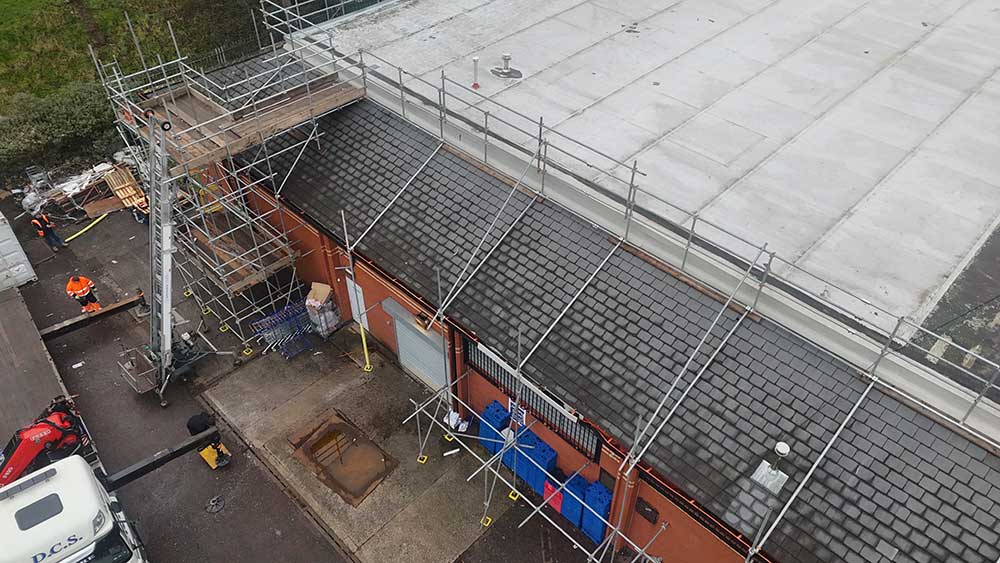
Falling object protection must address both immediate work areas and surrounding areas where debris could fall. Hard barriers—canopies, tunnel covers, or full scaffolding enclosure—provide positive protection preventing objects reaching ground level. Soft barriers—netting, catch platforms, or containment screens—arrest falling objects before they exit the work area. Exclusion zones established with barriers, signage, and active monitoring prevent personnel from entering areas where falling object risk exists.
The protection level should match risk assessment considering: roof work type (tear-off generates more debris than repair work), work height (higher roofs create larger potential impact zones), building surroundings (pedestrian traffic density, vehicle parking proximity), and weather (wind increases debris spread). Urban retail properties with heavy foot traffic require hard barriers preventing any debris escape, while industrial facilities with controlled access might rely on exclusion zones with periodic monitoring.
Hot work protocols for torch-applied systems, welding, or cutting operations above occupied spaces implement fire prevention and response measures. Fire watch personnel monitor work areas and spaces below for one hour after hot work completion, detecting and addressing smoldering before it becomes fire. Fire extinguishers and suppression equipment are positioned at work areas and accessible routes. Combustible materials are cleared from hot work areas, and spark-resistant covers protect roof assemblies and materials. Building management receives notification of hot work timing enabling HVAC system adjustment and fire suppression system awareness.
Hot work above occupied spaces containing combustibles—warehouses with stock, data centers with equipment, retail storage areas—requires particular attention including potential evacuation procedures if fire detection systems activate. Some insurance policies mandate hot work permits or notifications with premium implications if requirements aren’t met.
Access control and work zone definition prevents unauthorized personnel from entering active roof work areas where construction hazards exist. Physical barriers at roof access points (stair doors, ladder access, hoist areas) restrict entry to authorized personnel only. Signage identifying work zones, access restrictions, and safety requirements informs building occupants. Contractor responsibility for access control should be explicitly defined in contracts with penalties for unauthorized access that enables injury incidents.
Multi-tenant buildings with roof access from tenant spaces require coordination ensuring tenant personnel understand restrictions during roof work. Hotels must prevent guest access to roof-accessed amenity spaces during work periods. Office buildings with roof terraces implement access controls preventing employee entry to restricted areas.
Dust and contaminant control protects indoor air quality through containment, filtration, and monitoring. Temporary enclosures around work areas contain dust at source before it can infiltrate buildings. Building HVAC systems receive upgraded filtration (MERV 13-16 filters replacing standard MERV 8-11) during work period, capturing fine particulates before they reach occupied spaces. Negative pressure in work areas relative to occupied spaces prevents dust migration through pressure differentials.
Buildings with sensitive operations—data centers, medical facilities, laboratories, clean manufacturing—may require continuous air quality monitoring verifying particulate levels remain within acceptable ranges. If monitoring indicates unacceptable contamination, work suspends until enhanced controls bring air quality within specifications.
Traffic and loading coordination for material deliveries, equipment movement, and waste removal minimizes interaction between construction vehicles and building operations. Designated delivery times avoiding peak operational hours, specified approach routes minimizing impact on parking or access, and coordination with building loading dock schedules for shared facilities reduce conflicts. Contractors should provide advance notice of major deliveries enabling facility management to communicate impacts to affected parties.
Urban sites with on-street loading face particular challenges requiring temporary loading zone designations, traffic management, and neighbor coordination. Some local authorities require traffic management plans for construction deliveries exceeding certain vehicle sizes or frequencies.
Emergency evacuation planning accounts for roof work potentially blocking normal evacuation routes or creating hazards during emergency egress. Alternative evacuation routes are identified and communicated if construction blocks primary routes. Contractor personnel receive building evacuation procedure briefings enabling coordination if evacuations occur during work periods. Fire marshals know work locations and access points enabling emergency responder briefings if incidents require firefighter access to the roof.
Incident response protocols establish procedures for construction-related incidents affecting building occupants—falling debris injuring pedestrian, dust triggering asthma symptoms, noise causing medical emergency, or fire from hot work. Immediate response procedures (call emergency services, notify building management, secure work area), investigation requirements (preserve scene, gather witness statements, document conditions), and communication plans (internal notification, regulatory reporting if required) should be pre-established rather than improvised during crisis management.
The safety coordination framework should be documented in project-specific safety plans reviewed by building owner, contractor, and any affected tenants before work begins. Regular safety briefings during the work period—ideally weekly—review recent issues, reinforce critical protocols, and adjust procedures based on observed conditions. Safety isn’t bureaucracy adding cost and complexity—it’s fundamental protection against liability, business disruption, and moral responsibility for people working on or occupying the building.
Tenant and Staff Communication: Managing Expectations
Clear, consistent communication with building occupants addresses concerns proactively, manages expectations, and maintains goodwill despite inevitable inconveniences.
Initial notification (4-6 weeks before work) announces the project providing sufficient advance notice for tenants to plan around impacts. The notification should include: project purpose and scope (roof replacement, repair, upgrade), expected duration (start date, completion target, total timeframe), anticipated impacts (noise, dust, access changes, parking restrictions), work hour schedule (standard hours, extended hours, weekend work), contact information (project manager, facility management, emergency contacts), and tenant accommodation measures (what building owner is doing to minimize disruption).
The tone should balance honesty about impacts with reassurance about mitigation measures—acknowledge disruptions while explaining steps to minimize them. Avoid minimizing impacts (“you probably won’t notice anything”) which creates credibility problems when disruptions prove more significant than tenants were led to expect.
Project kickoff meetings for major work bring together tenants, building management, and contractor leadership providing face-to-face communication opportunities. Presentations explaining work scope, safety measures, and expected timeline with Q&A sessions address concerns directly. For multi-tenant properties, group meetings enable efficient communication while individual follow-ups address tenant-specific concerns.
Hotels typically conduct staff briefings rather than guest meetings, ensuring front desk, housekeeping, and management understand project scope enabling them to address guest questions accurately. Industrial facilities conduct safety briefings with operations personnel explaining work schedules, safety zones, and coordination protocols.
Regular progress updates (weekly) maintain communication momentum and address emerging issues promptly. Brief email updates or tenant portal posts describe completed work, upcoming activities, any schedule changes, and reminders about relevant impact mitigation measures. Photos showing progress reassure tenants that work is advancing toward completion rather than seeming interminable.
Updates should address problems honestly—if unexpected conditions cause delays, explain what happened and revised completion expectations rather than maintaining impossible original dates that erode credibility. Transparency about challenges builds trust that fosters patience, while evasion generates suspicion and frustration.
Real-time impact notifications provide same-day or advance notice of particularly disruptive activities. If crane lifts requiring parking restrictions are scheduled tomorrow, that afternoon’s notification enables tenants to plan alternative parking. If especially noisy tear-off work begins Monday morning, Friday communication sets expectations. Same-day notifications about unexpected issues (discovered damage requiring extended work, emergency repairs from storm damage) maintain communication rather than leaving tenants wondering why disruption increased without explanation.
Modern communication technology—email, SMS, tenant apps, building digital signage—enables rapid notification complementing periodic formal updates. However, multiple channels are necessary—not all occupants check email regularly, and urgent notices might require multiple contact methods ensuring message reaches relevant parties.
Feedback mechanisms providing occupants channels to report concerns, ask questions, or raise issues give voice to frustration while enabling facility management to address problems. Designated contact personnel (project manager, facility management lead) with clearly communicated contact information encourage direct communication rather than letting complaints fester. Regular feedback review—ideally daily during active work periods—enables rapid response to emerging issues.
Feedback should be acknowledged even when immediate resolution isn’t possible—responding to tenant complaint about noise with explanation of work requirements and remaining duration demonstrates concerns are heard even if noise can’t be eliminated. Ignoring complaints generates antagonism that persists long after roof work completes.
Special event coordination ensures critical business activities receive special consideration. Retail properties notify contractors of peak trading days requiring work suspension or modification. Hotels communicate high-profile guest arrivals or events needing construction restrictions. Office buildings note board meetings, client events, or critical project deadlines when disruption should be minimized if possible. Industrial facilities identify production runs or shipments requiring safety coordination or work restrictions.
This coordination enables contractors to plan around critical dates rather than discovering conflicts when it’s too late to accommodate. While contractors can’t suspend work indefinitely for occupant convenience, reasonable accommodation of genuinely critical dates fosters goodwill and cooperation.
Post-project follow-up after completion solicits feedback about overall experience, identifies any remaining issues requiring attention, and thanks occupants for patience during disruption. This closing communication maintains positive relationships, catches any final problems before they become grievances, and positions building management as responsive professionals who care about tenant experience.
For hotels, post-project guest surveys including questions about construction impact provide valuable feedback while signaling to guests that management takes their experience seriously. Retail properties might survey customers about accessibility and satisfaction during construction periods.
The communication investment throughout roof work—perhaps 5-10 hours weekly for facility management—prevents problems worth far more than the time invested. Tenants, guests, or staff who feel informed and heard tolerate disruption with patience; those left confused or ignored generate complaints, demand rent abatements, withhold cooperation, or in extreme cases terminate leases or boycott the property. The facility manager who communicates proactively manages disruption successfully regardless of work challenges; the manager who views communication as administrative burden discovers that ignored occupants become hostile adversaries rather than partners in project success.
Industry-Specific Considerations
Different commercial building types face unique operational challenges during roof work requiring tailored disruption management approaches.
Retail properties balance customer access, shopping experience, and sales performance with construction requirements. Visual screening—attractive temporary hoarding or signage—maintains professional appearance during work, with construction staging areas positioned away from main entrances and customer sightlines. Contractor access routes use service corridors or back-of-house areas rather than crossing sales floor whenever possible. Work schedules avoid peak shopping hours—no noisy activities Saturday 10am-5pm, or Friday evenings during extended shopping hours.
Major retail refurbishments increasingly implement night or weekend work despite premiums because sales impact from daytime construction can exceed 20-30% during affected periods—lost revenue dwarfing increased construction costs. The calculation differs by property—high-value fashion retailers in prime locations justify aggressive scheduling minimizing customer impact, while warehouse-style retailers tolerate more disruption accepting modest sales impact.
Hotels and hospitality prioritize guest experience and review impacts during construction periods. Guest room assignments during roof work concentrate guests away from construction areas when possible, with premium rooms and suites receiving priority in undisturbed areas. Front desk staff receive detailed daily briefings on work locations, expected noise periods, and appropriate guest responses. Amenity restrictions (pool closures, terrace access limits) are communicated during booking process and arrival, with alternatives offered when possible.
Major hotel roof projects increasingly implement room rate adjustments during construction—discounted rates acknowledging disruption maintain occupancy while compensating guests for reduced experience quality. This approach recognizes that construction impacts are real and guests deserve consideration rather than full-rate expectation during compromised experience periods.
Office buildings manage productivity impacts and tenant satisfaction during roof work. Conference room scheduling systems flag rooms below active work areas as inappropriate for external client meetings on days with significant noise. Temperature control challenges during roof work (exposed assemblies, HVAC shutdowns) receive proactive communication with portable cooling or heating provided in severely affected areas. Flexible work arrangements—remote work options, shifted schedules—accommodate employees particularly bothered by construction impacts.
Progressive office landlords recognize that tenant renewals depend on overall building experience, and mishandled construction creates leverage during lease negotiations. The tenant whose operations were severely disrupted by poorly managed roof work expects rent concessions at renewal, while the tenant whose landlord proactively managed disruption renews without demanding construction-impact-related reductions.
Industrial and warehouse facilities coordinate roof work with production schedules, safety requirements, and operational constraints. Work sequencing proceeds section-by-section enabling ongoing operations in unaffected areas while construction proceeds overhead in isolated zones. Safety coordination with below-roof operations is critical—fork trucks, overhead cranes, process equipment—requiring clear communication about work areas, potential falling debris zones, and any operational restrictions needed for safe construction.
Some industrial operations require roof work during production shutdowns or maintenance periods, concentrating roofing work into narrow windows between production runs. This drives aggressive scheduling, premium hours, and large contractor crews completing work within available timeframe despite premium costs—the alternative of extended production disruption costs far more than construction premiums.
Medical and healthcare facilities face stringent infection control, life-safety, and operational continuity requirements during construction. Dust and contaminant control reaches clinical standards with HEPA filtration, negative pressure containment, and continuous monitoring. Hot work near oxygen storage or medical gas systems requires special permitting and precautions. Work scheduling coordinates with medical procedures, visiting hours, and patient care routines—no noisy work during surgery hours or overnight near patient rooms.
Major hospital roof projects often require construction infection control committee review and approval before work begins, with ongoing monitoring verifying compliance throughout the project. These requirements substantially increase costs but are non-negotiable in healthcare environments where patient safety is paramount.
Data centers and technical facilities prioritize contamination control, environmental stability, and operational uptime during roof work. Particulate contamination that would be tolerable in office environments causes critical system failures in data center server rooms. Temperature and humidity excursions during roof work when HVAC systems are affected risk equipment damage or operational failures. Work must sometimes proceed with full redundant systems operating in case primary systems are compromised during construction.
The financial consequences of data center downtime (potentially thousands per minute) justify extraordinary construction costs and precautions. Roof work might proceed with multiple backup HVAC systems operating, continuous air quality monitoring, and immediate shutdown capabilities if contamination or environmental conditions exceed safe thresholds.
Understanding building-type-specific vulnerabilities and operational priorities enables facility managers to emphasize appropriate disruption mitigation measures rather than applying generic approaches that miss critical building-specific concerns.
Monitoring and Adjustment During Work
Continuous oversight during roof work enables real-time problem identification and correction before issues escalate into serious disruptions or tenant relations problems.
Daily site walkthroughs by facility management or designated representative provide direct observation of work progress, safety compliance, and emerging issues. Morning walkthroughs before work begins verify preparedness—safety measures in place, access controls established, required materials available. Mid-day checks during active work observe safety practices, assess disruption levels, and identify any problems requiring attention. End-of-day reviews confirm proper site securing, verify cleanup completion, and preview next day’s activities.
These walkthroughs need not be lengthy—15-30 minutes typically suffices—but consistent presence demonstrates oversight and provides opportunities for contractor communication outside formal meetings. Problems observed can be addressed immediately rather than waiting for weekly project meetings when issues have worsened or already caused complaints.
Occupant feedback monitoring through designated contact channels captures real-time reactions to construction impacts. Daily review of tenant comments, complaints, or questions reveals developing problems before they generate widespread dissatisfaction. Rapid response to feedback—even when immediate solution isn’t possible—demonstrates responsiveness that mitigates frustration.
Pattern recognition in feedback is critical—single complaint about noise might be individual sensitivity, but multiple complaints indicate work is genuinely disruptive requiring mitigation. Geographic patterns in complaints identify work areas creating worst impacts, enabling enhanced controls in those zones.
Safety incident tracking documents even minor events (small debris fall, near-miss, minor injury) revealing potential serious hazards before major incidents occur. Daily safety reviews with contractor supervision identify trends—particular work activities generating incidents, specific areas with elevated hazard levels, time-of-day patterns suggesting fatigue or rush-related problems.
Zero-tolerance for safety protocol violations demonstrates seriousness and prevents normalization of deviance where minor infractions go unaddressed until major incident occurs. This doesn’t mean punitive contractor relationships but rather clear expectations that safety standards are non-negotiable regardless of schedule or productivity pressure.
Environmental monitoring through measurements or observations verifies dust levels, noise exposure, and odor impacts remain within acceptable ranges. Simple monitoring—regular inspection of horizontal surfaces below work areas for dust accumulation, noise level meters assessing sound transmission to occupied spaces, air quality spot checks in sensitive areas—provides objective data supporting subjective occupant feedback.
If monitoring indicates impacts exceeding acceptable levels, work modifications (enhanced dust control, noise barriers, ventilation adjustments) become necessary regardless of contractor assertions that current practices are adequate. Building occupant experience determines acceptability, not contractor compliance with generic industry practices.
Schedule compliance tracking identifies early indicators of schedule slippage enabling corrective action before delays become severe. Work should proceed at expected pace, with reasonable progress visible daily or weekly. Unexplained slow progress suggests problems—weather impacts, labor shortages, unexpected conditions, or contractor capability issues—requiring investigation and potential intervention.
However, schedule pressure shouldn’t override safety or quality—rushing to meet deadlines creates incidents and long-term performance problems. The balance requires judgment distinguishing legitimate delays requiring schedule adjustment from contractor inefficiency requiring performance improvement.
Communication effectiveness assessment evaluates whether established communication plans are reaching intended audiences and achieving objectives. Are tenants receiving and reading updates? Do occupants know whom to contact with concerns? Is feedback generating timely responses? If communication isn’t working, methods or frequency need adjustment.
Some populations require more frequent or different communication—elderly hotel guests may not use email reliably, night-shift industrial workers might miss daytime meetings, and retail customers need different information than tenant management. Adapting communication to audience effectiveness rather than maintaining inflexible plans improves actual information flow.
Proactive problem solving addresses emerging issues through rapid corrective action. If tenant complaints spike about specific noise source, immediate investigation and mitigation (equipment modification, schedule adjustment, enhanced barriers) demonstrates responsiveness. If dust infiltration exceeds expectations despite containment, enhanced filtration and cleaning protocols implement before complaints multiply.
The monitoring philosophy emphasizes catching problems early when solutions are straightforward versus allowing issues to fester until they require expensive interventions or damage tenant relationships. Daily attention to multiple monitoring streams—site conditions, occupant feedback, safety indicators, schedule progress—enables management by prevention rather than crisis response.
Conclusion: Disruption Management as Core Competency
Commercial roof work on occupied buildings presents facility managers with challenge that extends well beyond technical roofing specifications—how to protect and upgrade crucial building systems while maintaining business operations, tenant satisfaction, guest experience, or production continuity. Success requires recognizing that disruption management isn’t secondary to roofing quality but rather equal priority deserving systematic planning, dedicated resources, and continuous attention throughout project execution.
The mathematics of disruption impact justify substantial investment in mitigation. A retail property losing 20% of £500,000 weekly sales for 8-week roof project sacrifices £800,000 in revenue—far exceeding the £50,000-£100,000 cost of aggressive scheduling, enhanced controls, or premium timing that would reduce disruption. A hotel experiencing 15% occupancy decline during 6-week roof project loses more in room revenue than incremental costs for night work or sophisticated screening would have required. Industrial downtime costs from poorly coordinated roof work can dwarf the entire roof project budget within hours.
These calculations argue strongly for facility managers treating disruption management as core project requirement rather than hopeful contractor good behavior. This means selecting contractors based partly on demonstrated disruption management competence, investing in protective measures and enhanced scheduling proactively rather than reactively, maintaining active project oversight throughout work periods, and communicating continuously with affected occupants managing expectations and addressing concerns promptly.
The building types facing most acute sensitivity—hotels, medical facilities, technical operations, high-value retail—justify aggressive disruption mitigation including premium scheduling, sophisticated controls, and enhanced oversight potentially adding 20-40% to base construction costs. This premium is insurance against operational impacts worth multiples of the investment. Buildings with greater disruption tolerance—warehouses, back-office operations, industrial facilities with flexible scheduling—can accept more standard approaches while still benefiting from systematic disruption planning.
Looking forward, facility managers planning roof projects should invest planning time understanding building-specific operational sensitivities, engaging occupants in disruption tolerance discussions, developing building-specific mitigation plans beyond generic specifications, selecting contractors based on disruption management capabilities alongside technical qualifications, and budgeting adequately for protective measures and schedule premiums that minimize business impact.
During work execution, active oversight through daily monitoring, rapid feedback response, continuous safety vigilance, and adaptive problem-solving converts plans into reality. The facility manager who remains engaged throughout the project—walking the site regularly, responding to tenant concerns promptly, monitoring safety compliance personally, and addressing problems immediately—achieves successful outcomes even when unexpected challenges emerge. The manager who delegates oversight completely and hopes for best discovers too late that problems ignored while minor became crises requiring expensive intervention and damaging tenant relationships.
The roof completed on schedule and within budget while maintaining positive occupant relations, generating minimal complaints, avoiding safety incidents, and preserving business operations represents project success regardless of whether technical specifications exceeded or merely met requirements. Conversely, technically perfect roof completed amid tenant complaints, safety concerns, and operational disruption represents failure despite meeting construction standards. The distinction lies entirely in recognizing that commercial roof projects are ultimately about maintaining business viability during necessary building improvements, with disruption management determining project success as much as roofing quality determines long-term performance.
Treat disruption management with the systematic attention it deserves—plan thoroughly, communicate clearly, oversee actively, respond rapidly—and roof work proceeds as managed interruption rather than operational crisis. The business operations continue with minimal impact, occupants tolerate temporary inconvenience with patience and understanding, and the completed roof protects the building for decades while the memory of construction disruption fades within weeks of project completion.