The British climate presents a unique challenge to commercial roofing systems—not through spectacular extremes but through relentless variability. Unlike regions with predictable wet and dry seasons, UK roofs face constant cycling between rain and sun, freeze and thaw, wind and calm. This continuous weathering, year after year, gradually degrades even well-designed roofing systems in ways that sudden catastrophic failures never would. Understanding exactly how UK weather ages different roofing materials, recognizing the seasonal patterns that accelerate deterioration, and implementing proactive maintenance timed to address weather-specific vulnerabilities extends roof lifespan, prevents premature failures, and protects the substantial capital investment your commercial roof represents.
For facility managers overseeing retail properties, hotels, industrial units, or mixed-use developments across the UK, weather isn’t an occasional concern—it’s the primary determinant of when your roof will need replacement and how much maintenance it requires in the interim. The same roofing system that might achieve 30 years in a stable climate may deliver only 20 in the UK without proper weather-aware maintenance. This ten-year difference represents tens of thousands of pounds in capital expenditure brought forward, plus the business disruption of premature replacement. The good news is that most weather-related roof degradation is predictable, preventable, and manageable through maintenance strategies aligned with UK seasonal patterns.
The UK Climate Reality: Why Our Weather Is Uniquely Challenging
British weather’s reputation for unpredictability reflects genuine climatic characteristics that distinguish UK conditions from other temperate regions and create specific challenges for commercial roofing.
High rainfall totals across extended periods rather than concentrated wet seasons mean UK roofs rarely dry completely. Western regions receive 1,000-2,500mm annually, eastern regions 600-900mm, but crucially this arrives throughout the year in frequent smaller events rather than monsoon patterns followed by long dry periods. Commercial roofs in Manchester or Glasgow might experience 150+ days with measurable rainfall annually, creating constant moisture exposure that prevents protective drying periods between rain events.
Freeze-thaw cycling particularly in late winter and early spring creates mechanical stress as water absorbed into roofing materials freezes, expands, and then thaws repeatedly. UK temperatures hover around freezing for extended periods rather than plunging deep into sustained winter cold, creating ideal conditions for frequent freeze-thaw cycles. Areas experiencing 30-50 freeze-thaw cycles annually—common across much of the UK—see accelerated weathering of porous materials like concrete, some membrane systems, and particularly older built-up felt roofs.
Wind exposure from Atlantic weather systems brings sustained moderate winds punctuated by severe storms. Coastal commercial properties and those on elevated sites face near-constant wind loading that fatigues fixings, lifts membrane edges, and drives rain into details that wouldn’t leak under vertical rainfall alone. The UK’s 2015-2020 period saw multiple named storms annually—Ciara, Dennis, Jorge, and others—each bringing gusts exceeding 70mph to exposed locations.
UV radiation variability between long summer days and short winter periods creates expansion-contraction cycling in membrane roofs and accelerates degradation of polymer-based materials. While UK UV levels are moderate compared to southern latitudes, the seasonal variation from 16+ hour summer days to 8-hour winter days creates thermal cycling that stresses roofing materials in ways constant conditions wouldn’t.
Temperature range from -10°C winter lows to 35°C+ summer peaks (increasingly common during heatwaves) spans 45°C—substantial thermal cycling that drives expansion-contraction in metal roofing, membrane systems, and sealants. Modern climate change has increased both summer peak temperatures and the frequency of mild wet winters, intensifying the weathering challenge.
Humidity and condensation from marine-influenced air masses create persistent moisture conditions even without rainfall. Coastal properties and those in high-humidity regions experience condensation within roof voids and on cold surfaces, promoting biological growth, accelerating corrosion of metal components, and degrading insulation performance over time.
Pollution and atmospheric contaminants particularly in urban and industrial areas contribute to roofing material degradation. Sulfur dioxide, nitrogen oxides, and particulates from traffic and industry chemically attack roofing surfaces, accelerate corrosion of metalwork, and support biological colonization by providing nutrients for algae and moss growth.
The combination creates a weathering environment where roofs never truly rest. Continental climates offer cold dry winters followed by hot dry summers, providing protective dry periods. UK roofs face year-round moisture exposure with temperature cycling and periodic wind and UV stress superimposed. This constant attack demands different maintenance approaches than climates with distinct wet and dry seasons.
How Rain and Persistent Moisture Age Roofing Systems
Water represents the primary weathering agent for UK commercial roofs, with effects that go well beyond simple leak occurrence.
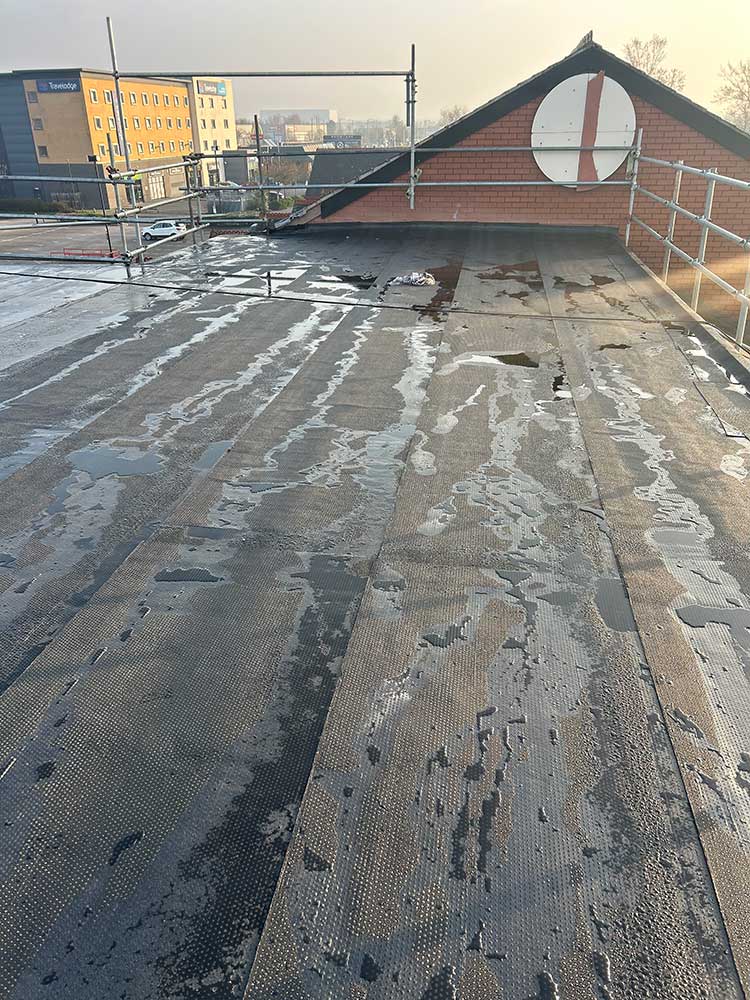
Standing water and ponding on flat or low-slope roofs creates concentrated exposure that accelerates membrane degradation. Areas where water stands for 48+ hours after rainfall experience accelerated UV degradation of the membrane surface, biological growth in the ponded water, and increased thermal cycling as standing water heats and cools. Modern single-ply membranes resist ponding better than older built-up felt, but even EPDM and TPO show measurable degradation acceleration in areas with chronic ponding.
Membrane softening and plasticizer migration occurs when bituminous and some polymer membranes remain wet for extended periods. Plasticizers that keep membranes flexible migrate to the surface in wet conditions, eventually leaving the base membrane brittle and crack-prone. This is particularly problematic for older built-up felt roofs where decades of UK rainfall have progressively depleted plasticizers, leaving membranes that crack under thermal movement or foot traffic.
Biological colonization by algae, moss, and lichen thrives in UK’s perpetually damp conditions. These organisms aren’t merely cosmetic issues—their root structures penetrate membrane surfaces creating micro-pathways for water ingress, their biomass retains moisture against the membrane prolonging wet periods, and their acidic secretions chemically attack roofing materials. A commercial roof in the UK northwest developing moss coverage within 5-7 years can experience 30-40% lifespan reduction if the growth isn’t managed.
Sealant and mastic degradation accelerates under constant moisture exposure. Modern polysulfide and polyurethane sealants resist moisture better than older mastics, but UK’s unrelenting damp still causes hydrolysis—chemical breakdown in the presence of water—that progressively softens and degrades sealant bonds. Upstands, penetrations, and detail work sealed at installation may show sealant failure within 8-12 years rather than the 15-20 years expected in drier climates.
Substrate saturation in older roofs without adequate vapor barriers sees moisture migrate through the roof buildup, saturating insulation and degrading deck materials. Timber roof decks in older industrial buildings or retail units can suffer progressive rot when persistent moisture from above combines with inadequate ventilation and vapor control. Concrete roof decks absorb moisture that then freezes during cold periods, spalling the concrete surface and creating substrate damage requiring expensive preparation before re-roofing.
Metal corrosion of fasteners, flashing, and structural elements accelerates dramatically under UK’s humid conditions. Mild steel components corrode 50-100% faster in persistently damp environments compared to regions with distinct dry seasons. Even stainless steel and aluminum show increased corrosion when exposed to UK coastal conditions where marine salt combines with moisture to create aggressive corrosive environments.
Drainage system deterioration from constant flow sees outlets, gutters, and downpipes accumulate debris, develop biological growth, and suffer mechanical wear. Outlets designed for occasional use face daily or twice-daily flow during UK’s frequent rainfall, wearing seals, eroding outlet throats, and creating maintenance demands commercial operators in drier regions never face.
The maintenance response to moisture-driven degradation centers on drainage optimization, biological growth management, and protective interventions that reduce membrane exposure to standing water and persistent damp. Roofs that shed water quickly and dry between rain events age far more slowly than those remaining constantly damp.
Wind Damage: Gradual Fatigue and Sudden Failure
Wind effects on commercial roofing range from slow mechanical fatigue to catastrophic storm damage, with UK’s combination of constant moderate winds and periodic severe storms creating particular challenges.
Edge and corner uplift from wind pressure differentials creates the highest loading on membrane edges, corners, and roof perimeters. Wind flowing over a building accelerates at edges and corners, creating negative pressure (suction) that attempts to lift the membrane. A commercial roof experiencing 15-20mph winds daily for months accumulates millions of loading cycles on edge fixings, gradually fatiguing mechanical attachments or degrading adhesive bonds until a moderate storm produces uplift that wouldn’t have occurred on a newer roof.
Fastener backing out in mechanically attached single-ply systems results from cyclic loading. Each wind event pulls on the membrane, transferring force to the fasteners, which gradually work loose from the deck over thousands of cycles. This is particularly problematic on larger retail or industrial roofs where long uninterrupted membrane runs develop substantial wind loads. Fasteners that were adequate at installation may be backing out after 7-10 years of UK wind exposure, not because they were undersized but because cumulative cycling has fatigued the connection.
Membrane cracking at penetrations develops where wind-driven movement flexes the membrane around fixed objects like vent stacks, air conditioning units, or roof-mounted plant. Each wind event cycles the membrane tension around these penetrations, eventually creating fatigue cracks that propagate with continued cycling. EPDM membranes show this particularly around square or angular penetrations where stress concentration is highest.
Flashing failure at upstands, parapets, and termination bars occurs as wind-driven membrane movement works against the fixed termination. Termination bars can vibrate loose, sealants fatigue and crack, and mechanical fixings pull through under cyclic loading. Hotel roofs with numerous HVAC penetrations and retail properties with extensive perimeter flashing face particular vulnerability to wind-driven flashing failure.
Debris impact damage from wind-borne materials creates penetrations and membrane damage. UK storms carry branches, advertising signage, construction debris, and even roof materials from neighboring properties, with impacts causing immediate damage or creating weak points that fail under subsequent weather exposure. Retail parks and industrial estates where multiple properties sit close together face particular debris impact risk during storms.
Water ingress at laps and seams results from wind-driven rain forcing water under overlaps designed only for vertical rainfall. UK’s frequent combination of wind and rain creates horizontal or even upward-driven precipitation that enters lap joints, membrane seams, and flashing details that would resist purely vertical water. This is why roofs that never leak during calm rain suddenly develop leaks during wind-driven storms—the water is entering through details adequate for normal conditions but vulnerable to pressurized wind-driven water.
Bituminous membrane uplifting on older built-up felt roofs occurs when bituminous adhesive ages and loses bond strength. Wind gets under membrane edges or at failed details, then progressively lifts larger areas as the aged bitumen releases. A small edge lift in a moderate storm becomes a large delaminated area in the next storm, cascading toward total membrane failure if not addressed.
The maintenance response to wind damage includes regular fastener inspection and tightening, edge and corner reinforcement before storm seasons, debris removal to eliminate wind-borne projectiles, and post-storm inspections to catch and repair small damage before it propagates. Crucially, addressing minor wind damage immediately prevents the progressive failure pattern where small problems become large failures in subsequent storms.
Freeze-Thaw Cycling: Invisible Mechanical Damage
Temperature cycling through the freezing point creates mechanical stresses that progressively damage roofing materials through expansion of ice within porous structures.
Membrane embrittlement occurs when water absorbed into membrane surfaces or edges freezes, creating ice crystals that mechanically stress the polymer structure. Modern EPDM and TPO resist this better than older materials, but even current membranes show measurable flexibility loss after years of freeze-thaw cycling. Membranes that were supple at installation become progressively stiffer, eventually cracking under thermal movement or mechanical stress.
Substrate spalling in concrete roof decks results from water penetrating surface pores, then freezing and expanding. Each freeze-thaw cycle damages the surface slightly, with cumulative cycling creating progressive surface deterioration. Older industrial properties with exposed concrete roof decks in areas seeing 30+ annual freeze-thaw cycles can lose 5-10mm of surface depth over a roof’s life, creating an increasingly rough substrate unsuitable for membrane adhesion without expensive preparation.
Insulation degradation when moisture has penetrated the insulation layer sees freeze-thaw damage to the insulation cells. Rigid insulation like PIR boards absorbs minimal moisture and resists freeze-thaw well, but older mineral wool or expanded polystyrene insulations that have become saturated through roof leaks or condensation suffer compaction and loss of R-value when frozen water damages cell structure.
Flashing and detail cracking at terminations where sealants and mastics have absorbed moisture develops cracks as frozen water expands within the sealant. Each thaw allows water to penetrate deeper into the crack, with subsequent freezing propagating the damage until seals that were adequate at installation have failed completely after years of freeze-thaw cycling.
Gutter and drainage ice damage occurs when water freezes in gutters, outlets, and downpipes, mechanically stressing these components. Repeated seasonal freezing can crack cast iron gutters, distort pressed steel systems, and damage outlet flanges. The mechanical damage from ice expansion combines with corrosion to accelerate gutter system deterioration beyond what moisture alone would cause.
Mortar and pointing deterioration in parapet walls, upstands, and copings accelerates under freeze-thaw cycling. Water absorbed into mortar joints freezes, expanding and creating micro-cracks. Successive cycles progressively degrade the mortar until it crumbles and falls out, eventually requiring complete repointing to prevent water penetration into the underlying masonry.
The freeze-thaw challenge peaks in late winter and early spring when temperatures oscillate around freezing. Properties in inland and northern UK locations experiencing frequent freeze-thaw benefit from pre-winter inspections ensuring minimal water absorption into vulnerable materials, and post-winter inspection addressing any freeze-thaw damage before the summer maintenance season.
UV and Heat Degradation: The Summer Challenge
UK summers may not match Mediterranean intensity, but cumulative UV exposure and increasingly frequent heatwaves create genuine degradation pressures.
Membrane surface chalking and hardening from UV oxidation progressively degrades polymer membranes. UV radiation breaks molecular bonds in the membrane surface, creating free radicals that react with oxygen to harden and embrittle the surface layer. Modern membranes include UV stabilizers, but these deplete over 15-20 years of exposure, after which degradation accelerates. Dark-colored membranes on south-facing roof slopes show this earliest, with chalky, brittle surface layers developing while underlying membrane remains sound—until cracks form in the degraded surface that eventually penetrate through.
Plasticizer migration to the surface accelerates during hot weather when increased membrane temperature mobilizes plasticizers. These migrate to the surface where they evaporate or wash away, progressively leaving the membrane more brittle. Built-up felt roofs on large retail or industrial properties can show measurable hardening after 10-15 UK summers, particularly in areas with good solar exposure.
Thermal movement stress from expansion during heat and contraction during cooling creates mechanical cycling at every penetration, edge, and transition. A commercial roof experiencing a 30°C temperature swing from cool night to hot afternoon can cycle through centimeters of expansion and contraction, stressing fasteners, working sealants, and fatiguing membrane attachments. Larger roofs like retail warehouses or distribution centers with 50+ meter uninterrupted runs experience substantial total movement that stresses details.
Sealant degradation accelerates under UV and heat exposure. Silicone sealants resist UV well but polyurethane and polysulfide products degrade measurably under combined heat and UV. Sealant beads on south-facing or unshaded elevations fail sooner than those in shade, creating variable maintenance requirements across a single building.
Metal surface degradation on standing seam metal roofs, flashing, and trim occurs as protective coatings degrade under UV exposure. Galvanized coatings lose zinc through weathering, paint films chalk and fade, and eventually the substrate metal begins corroding. While metal roofs are inherently durable, finish degradation can require recoating long before structural replacement is needed.
Bitumen bleeding and flow on built-up felt roofs during extreme heat creates surface irregularities and can lead to blistering. UK heatwaves reaching 35°C+ can soften bituminous layers enough to cause minor deformation, particularly on dark-colored surfaces in full sun. While rarely causing immediate failure, repeated summer softening accelerates overall degradation.
Biological acceleration during warm wet periods sees algae and moss growth explode. The combination of June-August warmth with UK’s persistent moisture creates ideal growing conditions. A roof that showed minor biological presence in spring can develop substantial moss coverage by late summer if not addressed.
The UV and heat maintenance response includes surface treatments that reflect UV and heat (white coatings, reflective systems), pre-summer cleaning to remove biological growth before it proliferates, and post-summer inspection of sealants and details that experienced the most extreme conditions.
Material-Specific Weather Vulnerabilities
Different commercial roofing systems respond differently to UK weather patterns, with vulnerabilities that inform material selection and maintenance priorities.
Built-up felt roofing represents the traditional UK commercial roofing approach but shows particular weather sensitivity. The multi-layer bitumen and felt construction is vulnerable to UV degradation of the surface layer, ponding water accelerating bitumen oxidation, freeze-thaw damage where water penetrates laps, and biological growth in the porous felt surface. Felt roofs in UK service typically show significant degradation by year 15-18, with western regions seeing faster deterioration than drier eastern areas. Maintenance priorities include surface dressing renewal, biological growth removal, and lap inspection/sealing.
Single-ply membranes (EPDM, TPO, PVC) perform well under UK conditions but aren’t immune to weather effects. EPDM shows excellent water resistance but can harden under long-term UV exposure, particularly on dark membranes. TPO resists UV better but is vulnerable to seam failure if installation wasn’t perfect and rain water gets under laps. PVC membranes resist biological growth well but plasticizer migration in wet UK conditions can lead to long-term embrittlement. All single-ply systems benefit from regular seam inspection, edge and corner checking, and fastener tightening where mechanically attached.
Liquid-applied membranes suit complex roof geometries with numerous penetrations but require perfect surface preparation and proper curing conditions—challenging in UK’s frequently damp weather. Once cured, liquid systems resist UK weather well, but any installation defects where inadequate curing occurred due to rain or humidity can create weak points that fail prematurely. Maintenance focuses on areas around penetrations where liquid membranes typically show first signs of degradation.
Standing seam metal roofing on commercial properties resists UK weather well structurally but requires coating maintenance. The metal itself (steel, aluminum, zinc) is durable, but protective finishes degrade under combined UV, rain, and pollutant exposure. Coastal locations see accelerated corrosion, industrial areas show acid rain effects, and all locations experience fastener backing out from thermal cycling. Metal roof maintenance includes fastener tensioning, coating renewal every 10-15 years, and seam inspection.
Green roofs and vegetated systems face UK weather well in concept—our climate suits plant growth—but require specific maintenance. Drainage layer clogging from plant debris, growing medium saturation during wet winters, wind damage to shallow-rooted plants during storms, and frost damage to plants during freeze-thaw all require attention. The waterproofing membrane beneath the green roof must be perfect because access for repair is difficult once the system is established.
Protected membrane roofs (inverted) with insulation above the membrane resist UK weather well by shielding the waterproofing from UV, thermal cycling, and mechanical damage. However, the ballast or paving on top requires drainage attention, wind uplift of ballast during storms is a risk, and any waterproofing damage is expensive to access and repair. These systems suit UK conditions where properly designed but aren’t maintenance-free.
Understanding your specific roofing system’s weather vulnerabilities allows targeted maintenance that addresses genuine risks rather than generic roofing maintenance that may miss critical issues specific to the material type and UK weathering patterns.
Seasonal Maintenance Calendar for UK Commercial Roofs
Aligning maintenance activities with seasonal weather patterns maximizes effectiveness while minimizing disruption and cost.
Spring (March-May): Post-Winter Recovery After winter’s freeze-thaw and storm damage, spring inspections identify problems before summer heat sets in. Key activities include: inspecting and repairing winter storm damage to membranes, flashing, and fixings; clearing debris accumulated over winter from gutters, outlets, and roof surfaces; inspecting seals and sealants for freeze-thaw damage and crack development; tightening fasteners loosened by winter wind exposure; inspecting and repairing any ice damage to drainage systems; and addressing any moss or algae growth before summer growth acceleration. Spring also provides ideal conditions for planned maintenance work—mild temperatures, improving weather, and avoiding summer heat or winter cold that complicate installations.
Summer (June-August): Biological Control and Preparation Summer’s combination of warmth and moisture accelerates biological growth while providing good working conditions for maintenance. Focus on: removing moss, algae, and lichen before growth becomes extensive; applying biocides or preventative treatments where appropriate; pre-storm season inspection of fixings, edge details, and vulnerable areas; addressing any ponding or drainage issues before autumn rains intensify; completing major repairs or replacements while weather is favorable; and inspecting and maintaining air conditioning equipment roof penetrations before peak summer cooling demand. Summer is also ideal for reflective coating application or repair where specified.
Autumn (September-November): Storm Preparation Preparing for winter storms and increased rainfall prevents problems during the challenging winter period. Priorities include: clearing all gutters, outlets, and drainage systems of summer vegetation and debris; inspecting and securing loose flashings, edge trims, and potential wind damage points; testing all drainage systems under heavy artificial water flow to identify blockages; trimming any overhanging tree branches that could drop debris or impact roof during winter storms; securing any roof-mounted equipment, signage, or installations that could come loose in high winds; and conducting comprehensive roof inspection to identify any vulnerabilities before winter weather arrives. Post-inspection repairs should be completed before weather deteriorates.
Winter (December-February): Storm Response and Monitoring Winter maintenance is primarily reactive, addressing storm damage promptly while avoiding unnecessary roof access during harsh conditions. Activities include: post-storm inspections particularly after named storms or high wind events; emergency repairs to prevent water ingress or further damage; monitoring weather forecasts and arranging standby cover for severe weather events; ensuring drainage systems remain clear despite challenging access conditions; and planning next year’s maintenance program based on winter observations. Major planned work is avoided during winter except emergency interventions, but planning and procurement for spring maintenance can proceed.
This seasonal approach concentrates resource-intensive maintenance during favorable conditions while ensuring weather-appropriate monitoring and intervention when needed. The calendar also aligns with business cycles—retail properties might intensify summer maintenance before peak trading periods, hotels might focus on spring preparation before summer guest season, industrial properties might align with production shutdown schedules.
Proactive Measures That Extend Roof Life in UK Conditions
Beyond reactive maintenance, specific proactive interventions demonstrably extend commercial roof lifespan under UK weather exposure.
Enhanced drainage design and maintenance prevents the ponding and standing water that accelerates membrane degradation. This includes: specifying additional roof outlets beyond minimum code requirements; installing scuppers or secondary drainage at low points; regular professional drainage inspection and clearing; and considering tapered insulation systems that eliminate low spots on re-roofing projects. A commercial roof that sheds water within hours rather than days of rainfall can achieve 30% longer service life through reduced membrane degradation alone.
Protective coatings and treatments shield membranes from UV, reduce thermal cycling, and inhibit biological growth. Reflective coatings reduce membrane temperature by 15-20°C during summer, dramatically slowing UV degradation and thermal fatigue. Biocide treatments prevent moss establishment, eliminating the root damage and moisture retention that biological colonization causes. Applied at 10-15 year intervals, protective treatments can extend felt roof life from 18-20 years to 25+ years, representing £15,000-£30,000 deferred capital expenditure on a typical retail property.
Edge and perimeter reinforcement addresses the highest stress areas that fail first under wind loading. Additional mechanical fastening at edges and corners, reinforcing fabric in laps near perimeters, and upgraded edge metal with enhanced fixing all prevent the edge lifting that often precipitates wholesale membrane failure. The modest cost of edge reinforcement—perhaps £3,000-£8,000 on a medium commercial roof—prevents £40,000-£100,000 premature replacement when wind damage propagates.
Regular professional inspection programs identify minor problems before they become major failures. Quarterly or bi-annual inspections by experienced roofing professionals catch developing issues—backing-out fasteners, degrading sealants, early membrane damage—that facility managers’ visual checks might miss. Early intervention on minor problems costs hundreds rather than thousands when those problems develop into leaks or structural damage. Many commercial roofing contractors offer inspection and preventative maintenance contracts that spread costs predictably while ensuring consistent attention.
Thermal imaging surveys identify wet areas in flat roof assemblies before leaks become visible inside. UK’s high humidity and frequent rainfall mean roofs often contain moisture even without obvious leaks. Thermal surveys during appropriate weather conditions (typically clear mornings after overnight cooling) show wet areas as temperature anomalies, allowing targeted repair of compromised membrane areas before they fail completely. A survey costing £800-£2,000 can identify problems that would otherwise cause £20,000+ leak damage to stock, finishes, or building fabric.
Plant and equipment mounting upgrades prevent the penetration proliferation that creates maintenance burdens. When roof-mounted plant requires replacement, consider upgrading mounting systems to reduce penetrations, improve drainage around bases, and enable easier future removal. The incremental cost of superior mounting details is modest compared to the long-term maintenance savings and reduced leak risk.
Gutter and downpipe oversizing beyond minimum requirements ensures drainage capacity during the intense UK rainfall events that are becoming more frequent. Existing gutter systems designed to older rainfall intensity data may be inadequate for current 1-in-10 or 1-in-20 year events. Upgrading drainage during roof refurbishment prevents the overflow and water backup that can damage building fabric and accelerate roof deterioration.
When to Replace vs. Repair: Weather-Influenced Decision Making
UK weather patterns inform the repair vs. replacement decision through understanding how remaining roof life relates to cumulative weather exposure.
Age-based replacement timing varies by material and weather exposure. Built-up felt roofs in high-rainfall western UK locations should be planned for replacement at 18-22 years, while the same system in drier eastern locations might achieve 22-25 years. Single-ply membranes can reach 25-30+ years with good maintenance, but early replacement at 20-25 years may be financially optimal if major repairs are becoming frequent. The question isn’t “is the roof leaking?” but “what’s the probability of significant weather-related failure in the next 3-5 years versus replacement cost?”
Repair frequency escalation signals approaching end-of-life. If a roof required repair intervention once in years 1-10, twice in years 11-15, and is now needing attention 3-4 times in years 16-18, weather-driven degradation is accelerating and replacement is likely more economical than continued repair. The UK weather exposure that the roof has already survived is progressively weakening the materials, making future weather events more likely to cause problems.
Insurance and risk considerations shift the equation when the cost of a potential weather-driven roof failure exceeds the cost of proactive replacement. A retail property where roof failure during peak trading season could cost £200,000 in lost sales plus emergency repair costs might justify replacing a 16-year-old roof that could technically limp to 20 years, because the risk exposure over those four years exceeds the cost of planned replacement with associated business continuity.
Energy performance opportunities make replacement attractive when improving insulation and reducing energy costs can partially fund roofing upgrade. UK building regulations now demand high thermal performance on commercial reroofing, and the reduced heating costs from improved insulation—potentially £5,000-£15,000 annually on a large retail or industrial property—create a financial case for replacement before strictly necessary from weatherproofing perspective alone.
Planned vs. reactive replacement timing is heavily weather-influenced. Planned summer replacement of a marginally adequate roof proceeds smoothly with minimal business disruption. Emergency winter replacement of the same roof after storm damage costs 30-50% more, disrupts operations severely, may cause additional damage to stock or finishes during the emergency period, and proceeds under challenging conditions that compromise quality. The weather resistance remaining in an aging roof determines whether you can plan replacement timing or whether winter storms will force your hand.
The optimal approach for most UK commercial properties is replacement planning at 75-80% of expected service life, allowing 2-3 years to budget, schedule, and execute replacement during favorable conditions while the roof still has adequate weather resistance to avoid emergency failure. This differs from “run it to failure” approaches that work in more benign climates but risk expensive emergency interventions when UK weather tests degraded roofing systems beyond their remaining capacity.
Storm Season Preparation Checklist
As autumn approaches and the UK storm season begins, specific preparation reduces damage risk and improves emergency response capability.
Pre-season roof inspection 4-6 weeks before typical storm season onset (September-October) identifies vulnerabilities while time remains for correction. Focus on: all edge and perimeter details for secure attachment and proper termination; mechanical fasteners across the roof field for any backing out or loosening; flashings, terminations, and penetrations for secure fixing and proper sealing; drainage systems for clear flow and adequate capacity; and roof-mounted equipment for secure fixing and proper anchorage. Document condition with photographs and detailed notes enabling post-storm comparison.
Drainage system verification ensures capacity to handle high-intensity rainfall. Clear all gutters, outlets, hoppers, and downpipes of debris. Test with high water flow (fire hose or similar) to verify water movement under stress conditions. Confirm overflow routes are clear. Identify and address any areas where water backs up or drains slowly. The goal is ensuring storm water exits the roof quickly rather than accumulating weight or finding alternative paths through building fabric.
Loose material and debris removal eliminates wind-borne projectiles that damage roofing during storms. Remove or secure any tools, equipment, signage, or materials stored on the roof. Ensure any temporary installations are removed or properly secured. Check surrounding areas for debris that could blow onto your roof from neighboring properties.
Emergency contact and response plan enables rapid response when storms cause damage. Ensure facility management team has 24/7 contact details for your roofing contractor, emergency response companies, and any specialist suppliers. Prepare internal emergency protocols for roof damage response. Brief relevant staff on initial damage assessment and water ingress response procedures. Confirm insurance notification requirements and claims procedures. Having response plans prepared before storms arrive enables faster intervention when damage occurs.
Standby resource arrangement for critical properties where roof failure creates substantial business impact justifies pre-arranged emergency response. Some commercial roofing contractors offer standby arrangements where they commit to responding to your property as a priority during storm events, often for an annual retainer. For retail properties approaching peak trading season, hotels during high occupancy periods, or industrial operations where weather-related downtime is extremely expensive, the retainer cost is modest insurance against extended disruption while contractors work through multiple storm damage calls on a first-come first-served basis.
Tenant or occupant notification in multi-let properties ensures all parties know to report roof issues promptly. Brief tenants on signs of roof problems (water stains, drips, membrane movement visible from windows) and provide clear reporting procedures. Quick notification enables faster response before minor weather damage develops into major water ingress.
Post-storm inspection protocol determines what to check and when. Plan to inspect roofs as soon as safe access is possible after major storms—typically once winds subside below 25mph. Know what to look for (membrane damage, standing water, displaced edge metals, loose material) and document all findings. Address urgent problems immediately while planning less critical repairs for better conditions.
The preparation investment—typically 1-2 days of professional inspection plus any identified remedial work—is modest compared to storm damage costs on unprepared properties. Preparation shifts the odds from reactive emergency management to proactive risk reduction, with substantially better outcomes for building performance and business continuity.
Conclusion: Weather-Aware Roofing for UK Commercial Properties
The UK climate represents a challenging environment for commercial roofing systems—not through dramatic extremes but through relentless, cumulative weathering that progressively degrades even well-designed roofs. Understanding the specific weather mechanisms that age roofing materials, recognizing how different systems respond to UK conditions, and implementing maintenance strategies aligned with seasonal weather patterns transforms roofing from an expensive periodic crisis into a managed asset where lifespan is maximized and failures are prevented rather than repaired.
The difference between a commercial roof achieving 15 years before premature failure versus delivering 25+ years of reliable service isn’t material quality alone—it’s the match between material selection, maintenance approach, and UK weather realities. Built-up felt roofs that receive regular surface treatment, biological control, and proactive drainage maintenance can outlast neglected single-ply systems despite the latter’s theoretical superior weather resistance. The maintenance program matters as much as the roofing specification.
For facility managers, property directors, and business owners overseeing commercial properties across the UK, the practical implication is clear: weather-aware maintenance isn’t optional—it’s fundamental to protecting capital assets and avoiding expensive disruption. A £3,000-£8,000 annual maintenance program on a commercial roof saves £50,000-£150,000 in premature replacement costs, prevents business disruption from weather-related failures, and provides the predictability that capital planning requires.
As climate change increases the frequency of intense rainfall events, extends warm periods favoring biological growth, and potentially increases storm severity, the importance of proactive weather-aware roofing maintenance only grows. Properties that implement seasonal maintenance cycles, address weather-specific vulnerabilities, and replace proactively rather than reactively will outperform those treating roofing as an inert building element requiring attention only when problems manifest. The roof is your building’s primary weather protection—treat it with the ongoing attention UK weather demands, and it will deliver the decades of reliable service that your building operations require.
The storm season approaches every autumn regardless of preparation state. The question is whether your commercial roof enters that season with known vulnerabilities addressed, drainage capacity verified, edges and details secured, and emergency response planned—or whether you’re hoping this year won’t be the one where deferred maintenance and accumulated weather exposure combine to create the failure that reactive maintenance can never prevent. Choose weather-aware proactive management, and choose it before the storms arrive.