Falls from height remain the single largest cause of fatal workplace injuries in the UK, accounting for around a quarter of all worker deaths each year. Yet for many facility managers, roof access safety sits in an uncomfortable gap between what they know they probably should have in place and what they have actually documented, specified, and installed.
This guide is not a generic health and safety overview. It is a direct account of what the law requires of you as the person responsible for a commercial property, what compliant systems look like in practice, what they cost, and where your legal exposure lies when contractors work on your roof.
1. The Legal Framework: Working at Height Regulations 2005
The Working at Height Regulations 2005 (WAHR 2005) form the primary legal obligation for anyone who controls or commissions work at height. They apply without a lower-height threshold — there is no minimum distance from the ground at which they begin to apply.
As a facility manager or building owner, you are a dutyholder under these Regulations even when the work is being carried out by an external contractor. Regulation 4 is clear on this: every employer, and every person who controls the way in which any work at height is carried out, must ensure that the work is properly planned, supervised, and carried out by competent people.
The Hierarchy of Control (Regulation 6)
The Regulations set out a strict hierarchy that must be followed in order:
- Avoid work at height altogether where it is reasonably practicable to do so.
- Where work at height cannot be avoided, use work equipment or other measures to prevent a fall.
- Where the risk of a fall cannot be eliminated, use work equipment or other measures to minimise the distance and consequences of a fall.
For routine access to a commercial flat roof — maintenance, inspection, M&E servicing, or gutter cleaning — avoiding the work is rarely an option. That means your legal obligation shifts immediately to providing compliant fall prevention, not just fall mitigation.
Key Legal Point: Providing a ladder and a copy of someone’s CSCS card is not sufficient compliance with WAHR 2005. You are required to have assessed the risk, specified appropriate collective protective measures, and ensured they are in place before any work begins — including work by third-party contractors.
Who Is Responsible?
Responsibility under WAHR 2005 does not sit with the contractor alone. The Health and Safety at Work etc. Act 1974 (Section 3) places a duty on every employer to conduct their undertaking in such a way that persons not in their employment are not exposed to risks to their health and safety. Facility managers and building owners are within scope of this duty.
The Construction (Design and Management) Regulations 2015 (CDM 2015) add a further layer for building owners and principal designers on notifiable projects, but even for routine maintenance, the client duty to make suitable arrangements under CDM 2015 Regulation 4 is engaged.
2. Required Edge Protection Systems for Commercial Properties
Edge protection is the most fundamental collective control measure for any accessible roof. British Standard BS EN 13374 defines the performance classes for temporary edge protection systems, while BS 6180 covers permanent barriers.
BS EN 13374 Performance Classes
- Class A: Prevents falls on shallow slopes up to 10 degrees. The minimum requirement for flat or near-flat commercial roofs.
- Class B: For slopes between 10 and 30 degrees. Required on pitched commercial roofs.
- Class C: For slopes over 30 degrees where a person could generate significant momentum before reaching the edge.
What Does Compliant Edge Protection Actually Look Like?
For a commercial flat roof, a compliant edge protection system under BS EN 13374 Class A typically includes:
- A top rail at a height of between 950mm and 1,200mm above the working level.
- An intermediate rail positioned so that no gap exceeds 470mm.
- A toe board or kick board of at least 150mm height to prevent tools or materials from rolling off the edge.
- A system capable of withstanding a 0.3kN/m horizontal load applied at the top rail as a minimum.
Many commercial roofs in the UK — particularly those built before the mid-2000s — have no edge protection whatsoever, or have protection that meets neither the height nor the structural performance requirements. A visual inspection by a competent person is the first step to understanding your exposure.
Common Non-Compliance Issues: Single-rail barriers below 950mm height; pipework or plant equipment used as makeshift barriers; roped-off areas with no physical barrier; and edge protection that has not been inspected or load-tested since installation. Any of these could constitute a breach of WAHR 2005 and could expose you to enforcement action or civil liability.
3. Permanent vs. Temporary Access Solutions
The choice between permanent and temporary fall protection is determined primarily by the frequency and nature of roof access. The Regulations require a proportionate response, but proportionate does not mean minimal.
Permanent Access Systems
Permanent systems are the appropriate choice for any roof that is accessed more than occasionally. Typical triggers include:
- Routine maintenance of rooftop plant (HVAC, ventilation, lifts, solar panels).
- Scheduled gutter inspection and clearance.
- Any roof where access is required more than twice per year.
- Any roof accessed by multiple contractors or trades.
Permanent systems include fixed steel guardrail systems, non-slip GRP walkways with integral kerb rails, fixed access ladders with cage protection or self-closing gates, and roof access hatches with compliant guardrail collars. These systems are designed to BS 6180 and typically have a service life of 25 years or more when correctly installed and maintained.
Temporary Edge Protection
Temporary systems are appropriate for short-duration, one-off access events where a permanent system would be disproportionate. However, they must still meet BS EN 13374 performance requirements. Key limitations include:
- A competent person must specify, install, and inspect them before use on every occasion.
- They cannot be left in position between visits without a re-inspection.
- They are not suitable as a substitute for permanent protection on frequently accessed roofs.
- They add cost and time to every access event, often making a permanent solution more economical over a three-to-five year horizon.
Access Ladders and Hatches
Roof access itself must be assessed. Fixed access ladders must comply with BS 4211 and include a safety cage or fall arrest system where the climb height exceeds 2.5 metres. Roof access hatches must open to a minimum clear opening of 600mm x 600mm and must not open onto an unprotected area.
4. Anchor Point Specifications
Anchor points — whether for personal fall arrest, rope access, or rescue systems — are the most technically demanding element of a roof safety system. Incorrect specification or installation can result in anchor failure under load, with fatal consequences.
BS EN 795 Classes
- Class A: Structural anchors fixed to walls, roofs, or other structural elements.
- Class B: Portable anchor devices usable without permanent fixing.
- Class C: Horizontal lifeline systems — a flexible anchor line with two or more anchor points.
- Class D: Rail systems providing a running track for the user.
- Class E: Dead weight anchor devices used on flat roofs.
For most commercial flat roofs, Class A static anchors or Class C horizontal lifeline systems are the appropriate specification. Class A anchors must be designed to withstand a minimum static test load of 12kN per anchor.
Structural Verification
An anchor point is only as strong as the substrate it is fixed into. Before specifying or installing any anchor system, a structural engineer must assess the roof deck — whether concrete, metal decking, timber, or another substrate — and confirm that the fixing method and load path are adequate.
For older commercial roofs with built-up felt or single-ply membrane systems, this verification is especially important, as the structural capacity of the roof deck may have been compromised by water ingress, rot, or section loss that is not apparent from a surface inspection.
Inspection and Re-certification
Anchor points must be inspected by a competent person at least annually, and after any event that may have loaded or damaged them. Class C horizontal lifeline systems require inspection by the manufacturer or a specialist at least every 12 months. Records must be retained and made available to any person using the system.
Anchor Point Checklist: Confirm the number of users and maximum simultaneous load. Obtain a structural engineer’s sign-off on the roof deck capacity. Specify the correct BS EN 795 class for the intended task. Use an installer with third-party accreditation (IRATA, PASMA, or equivalent). Register the installation and set a 12-month inspection calendar entry on the day of installation.
5. Costs of Compliant Walkway and Guardrail Systems
The figures below are indicative benchmarks for UK commercial installations and should be treated as starting points for budget planning, not fixed quotes.
| System / Component | Typical UK Cost | Duration | Compliance Level |
|---|---|---|---|
| Temporary edge protection (per metre) | £15–£35/m | Days to weeks | Low |
| Fixed steel guardrail system (per metre installed) | £80–£200/m | Permanent | High |
| Non-slip GRP walkway (per metre run installed) | £120–£280/m | Permanent | High |
| Single static anchor point (installed) | £150–£400 each | Permanent | High |
| Horizontal lifeline system (per run) | £800–£2,500+ | Permanent | High |
| Full roof access package (medium flat roof) | £8,000–£25,000+ | Permanent | High |
Factors That Affect Cost
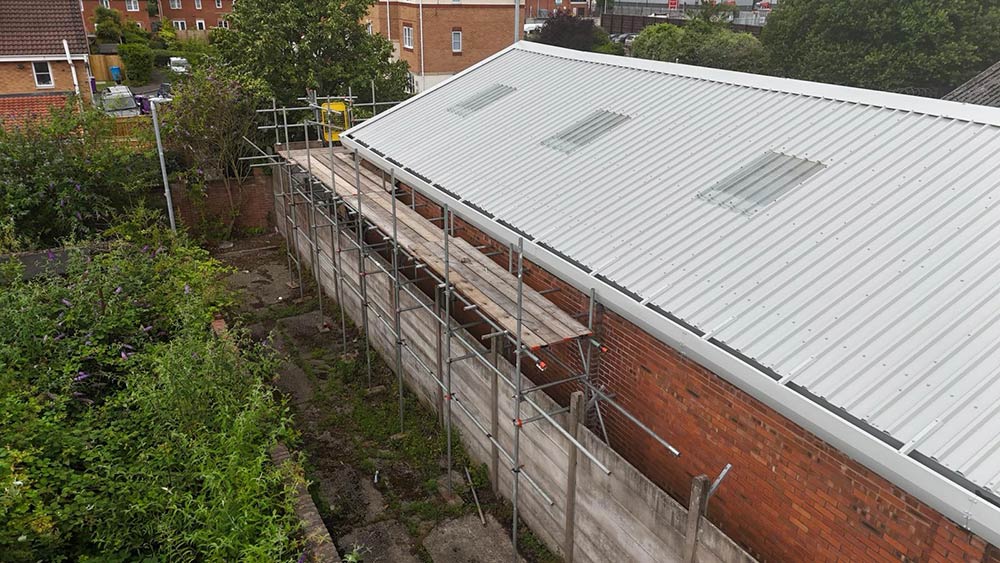
- Roof access: Roofs only accessible by rope access or scaffold will add 20–40% to installation costs.
- Substrate condition: Degraded or waterproofed decks may require remedial work before fixings can be made.
- Complexity of layout: Rooflight arrays, plant equipment, and multiple level changes increase design complexity.
- Specification standard: Systems certified to BS 6180 or BS EN 795 cost more than non-certified alternatives, but they are the only systems that give the duty holder a defensible compliance position.
The Cost of Non-Compliance
Following a fatal fall from height, prosecutions routinely result in six-figure fines for medium-sized businesses, and personal liability for directors and facility managers under the Health and Safety at Work Act. The cost of a compliant guardrail system installed on a medium commercial flat roof — typically £10,000–£18,000 — should be considered against that backdrop.
6. Liability When Contractors Work on Your Roof
There is a widespread assumption that once you have appointed a contractor with the right insurance and accreditations, your liability effectively transfers to them. This is not how the law works.
The Shared Duty Position
Under WAHR 2005 Regulation 4, liability is shared between the employer of the workers and the person who controls the way the work is carried out. As a facility manager or building owner, you control two critical aspects: whether the roof is in a condition that allows safe access, and what permanent safety equipment is in place. A contractor cannot be held solely responsible for a fall that results from an unguarded roof edge that you, as the building controller, were responsible for protecting.
Under the Occupiers’ Liability Act 1957, you owe a common duty of care to all lawful visitors — which includes contractors. If a contractor falls from an unguarded edge on your roof, the HSE will investigate the actions of both the contractor and the building owner or manager. In many cases, enforcement action is taken against both.
What You Should Require From Contractors
- A method statement and risk assessment specific to your roof, not a generic document.
- Evidence that the contractor has reviewed your existing edge protection, anchor points, and access arrangements.
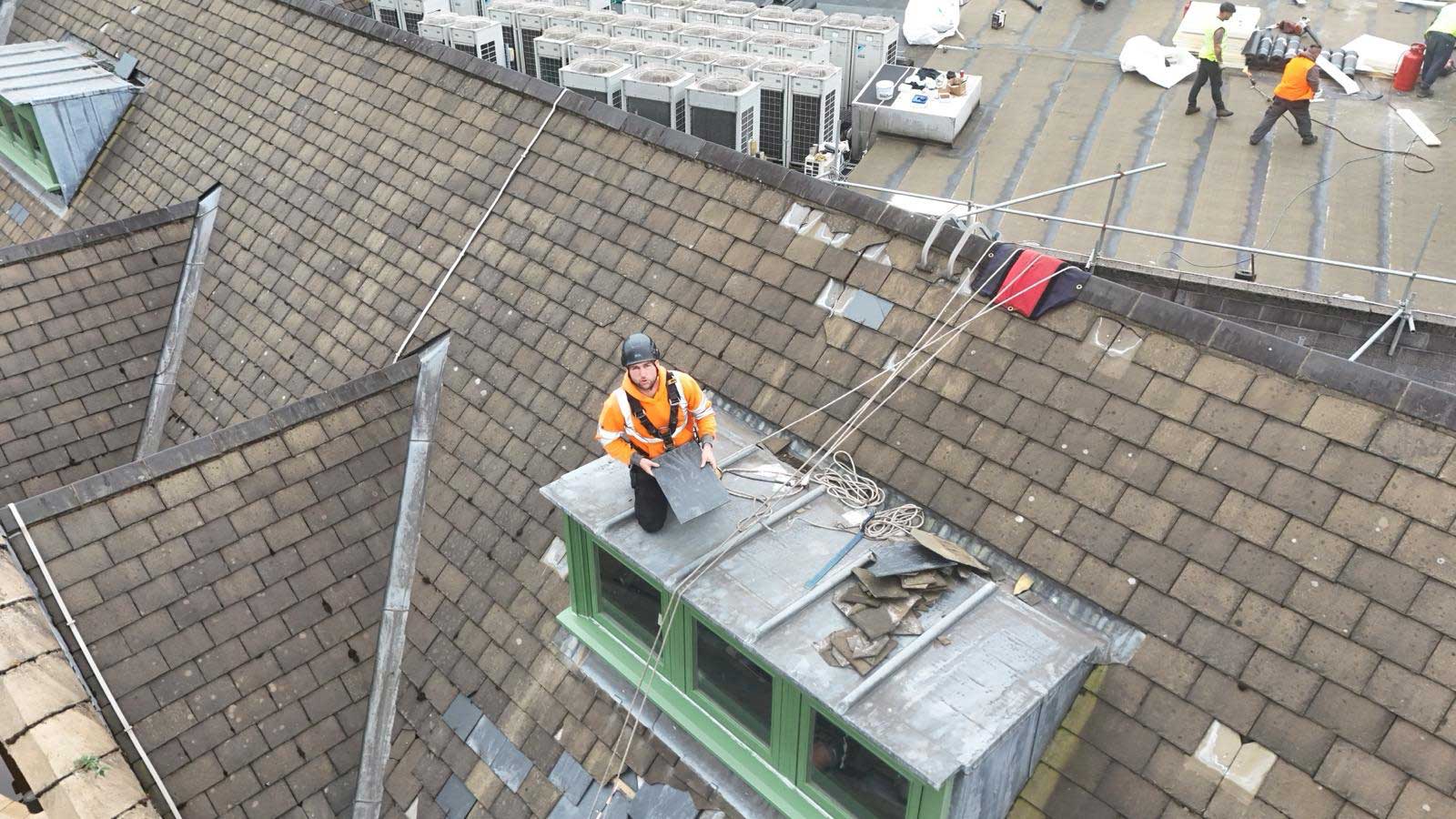
- Confirmation of the PPE each operative will use, including the specific harness standard (EN 361), lanyard type, and energy absorber.
- Competency evidence: for rope access, IRATA Level certification; for work at height generally, PASMA, IPAF, or equivalent.
- Contractor insurance that specifically covers work at height, with appropriate public liability limits.
What Contractors Can Legitimately Expect From You
- That existing permanent anchor points have been inspected within the last 12 months and a current inspection certificate is available.
- That edge protection systems have been maintained and that any defects reported by previous contractors have been remedied.
- That access routes to the roof are safe and the load-bearing capacity of the roof deck is known and communicated.
- That there are no concealed fragile roof elements — such as rooflights obscured by debris — that could constitute a through-the-roof fall hazard.
Practical Liability Reduction: Maintain a Roof Access Register — a single document recording all permanent safety equipment on your roof, its inspection dates, any defects noted, and all contractor visits. This is the first thing an HSE inspector will request following an incident.
7. Where to Start: A Facility Manager’s Action Plan
If you are not confident that your current roof safety arrangements are fully compliant, the following sequence is a practical starting point:
- Commission a roof safety survey from an accredited contractor. This should assess edge protection, anchor points, access ladders and hatches, fragile roof elements, and drainage — and produce a written report with a prioritised remediation schedule.
- Establish whether you have any existing certified anchor points, and if so, whether their inspection records are current and accessible.
- Review your contractor management process to confirm you are obtaining site-specific risk assessments and method statements, not generic documents.
- Create or update your Roof Access Register and establish a recurring 12-month inspection schedule for all permanent safety equipment.
- Engage a specialist contractor with demonstrable experience in commercial roof safety systems to specify and install any missing or non-compliant elements, with independent certification against the relevant British Standards.
RMLFS operates across the UK, working with facility managers, property directors, and estates teams to assess, specify, and install compliant roof access and safety systems as part of broader maintenance and refurbishment programmes. Our team holds CHAS, SafeContractor, NFRC, and Constructionline accreditations, and all roof safety installations are delivered in accordance with the relevant British Standards and WAHR 2005 requirements.
If you have concerns about your roof’s current safety provision, contact our team for a no-obligation assessment.